
Review · PRAGUE
Prague: Castle Tour with Local Guide and Entry Ticket
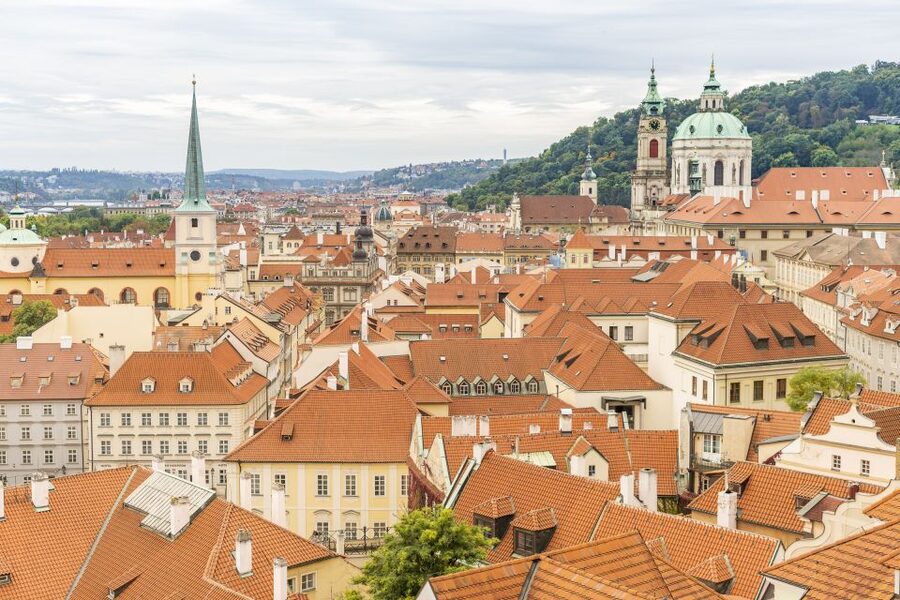
Prague Castle is less a single building than a small historic district on a hill. This 150-minute guided tour gives you a useful route through its grandest interiors, from St. Vitus Cathedral to Golden Lane, without leaving you to guess which doorway matters. I like the tram ride up and the live commentary through headphones, which helps when the cathedral is crowded. The main consideration is group size: small-group does not always mean tiny, with one recent group reaching 19 people.
I especially like two things here. First, the guide links the castle to Prague’s wider story, including the Defenestration of Prague and the country’s difficult past. Second, the ticket and short security line save effort at a complex where it is easy to lose time. Winter visitors should dress warmly, since some time is spent outdoors, and official closures can occasionally change the route.
Key points at a glance
- Tram ride included: Meet at Malostranská and ride up to Prague Castle instead of tackling the hill on foot.
- Headphones make a real difference: You can hear the guide while looking around, taking photographs or moving through crowded rooms.
- Four major sights included: The ticket covers St. Vitus Cathedral, the Old Royal Palace, St. George’s Basilica and Golden Lane.
- History comes with the buildings: Expect stories about St. Wenceslas, Charles IV, the Habsburg period and the Thirty Years War.
- Small-group or private option: Check the booking choice carefully, since group size can vary.
- A useful value at $61: The price includes the tram, admission, guide, commentary, headphones and the short security line.
Why a guided Prague Castle visit helps
Prague Castle can look simple on a map, but its sights are spread through a large complex. You are not just visiting one palace. You are moving between a cathedral, royal rooms, a basilica, an old lane of cottages and several courtyards, each with its own period and purpose.
That is why I think a guide earns the ticket price here. Without context, you may admire the stained glass and carved stone, then move on without understanding who used the building or why it mattered. A good guide turns a series of impressive rooms into a story about Czech rulers, religion, rebellion and everyday life.
The guides on this experience include Ross, Hannah, Anna, Tomáš, Marcela, Barbara and others, depending on the departure and language. The strongest pattern is clear spoken commentary, a friendly manner and plenty of historical detail. Ross is often praised for mixing facts with small stories and humor, while Hannah is noted for a calm, welcoming style. Tomáš and Marcela are also described as engaging and good at connecting the castle to Prague’s wider past.
You should still expect a real group tour, not a private conversation, unless you book the private option. One group had 19 people, which is manageable with audio equipment but larger than some people expect from the phrase small group.
More Castle Entry Tickets in Prague
- Prague Castle 2.5-Hour Tour Including Admission Ticket
★ 4.7 · 8,927 reviews - Prague: Prague Castle and Lobkowicz Palace Entry Tickets
★ 4.4 · 5,066 reviews - Prague Castle Tour Including Admission Ticket – 2.5 Hour
★ 4.5 · 1,171 reviews
Meeting at Malostranská and taking the tram uphill
The meeting point is directly outside the exit of the Malostranská metro station, near a small water fountain. Look for the brown and white Meeting Point sign and a guide with an orange umbrella. The fountain may be covered in winter, so the sign and umbrella matter more than the fountain itself.
From the metro, take the second escalator and go left. If you arrive by tram at Malostranská, cross the street and walk toward the metro station. Give yourself enough time to find the correct exit. A busy underground station is not the place to discover that you are standing on the wrong side of the road.
The tram ticket is included, and the ride up is a practical part of the tour rather than a decorative extra. Prague Castle sits above the Lesser Town, and the tram saves your legs for the courtyards and interiors. Several people especially like this arrangement because it avoids spending energy on the climb.
Once you reach the castle area, the guide takes care of the route and entry process. You receive headphones so you can hear the commentary without pressing close to the guide. This is one of the tour’s best features. In the cathedral, where other groups may be moving around you, you can pause briefly for a photograph and still follow the explanation.
St. Vitus Cathedral, from stained glass to royal tombs
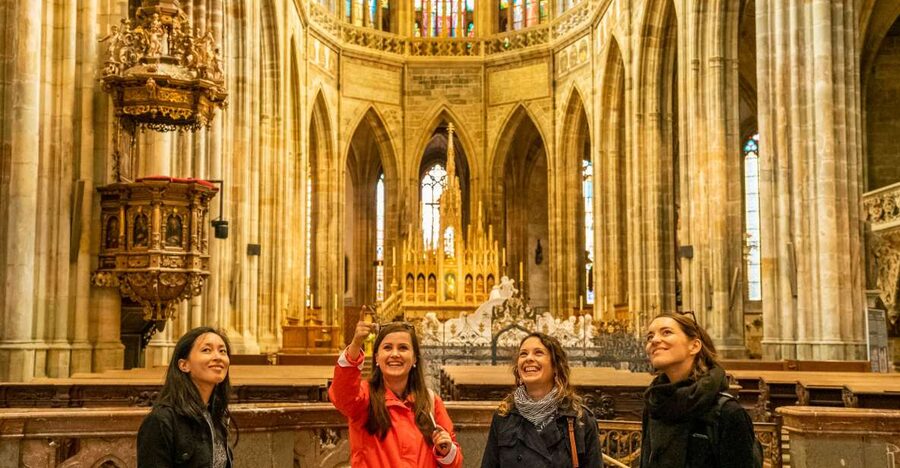
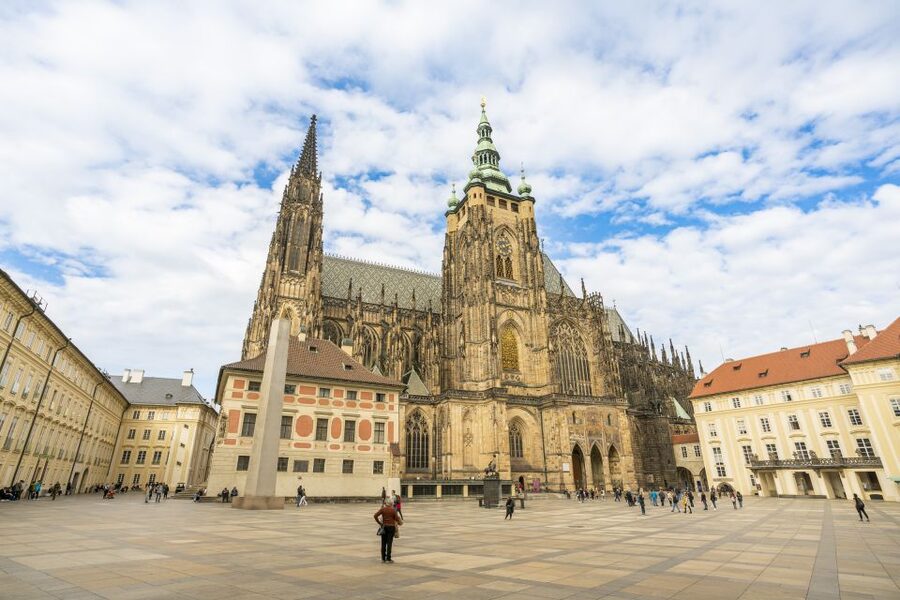
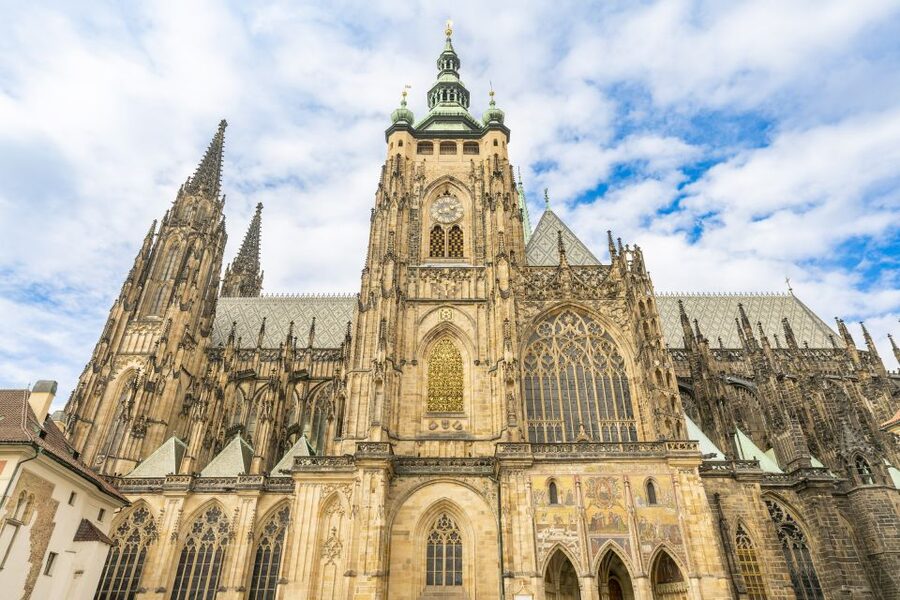
St. Vitus Cathedral is the tour’s grandest stop. Its Gothic exterior is lined with gargoyles, and the interior rises in a way that makes ordinary conversation feel very small. You get a focused introduction rather than wandering through the church with no sense of what to look for.
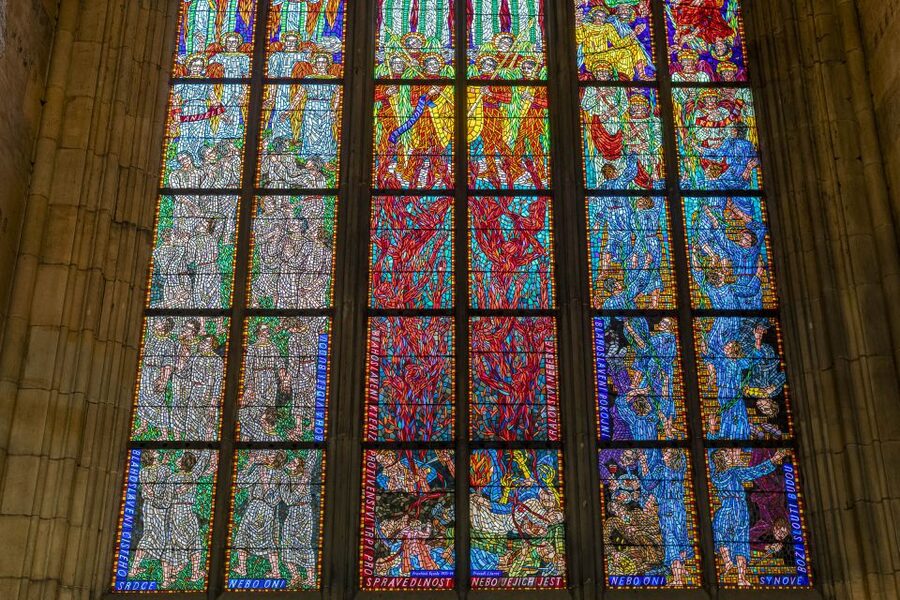
One major detail is the Art Nouveau stained-glass window by Alfons Mucha, one of the Czech lands’ most famous artists. The window adds a burst of color and modern style to a church otherwise shaped by medieval and later traditions. Your guide can point out why it differs from the older glass around it.
Look also for the 14th-century mosaic of the Last Judgment. It is an important reminder that the cathedral’s decoration is not limited to the interior. The exterior carries its own visual story, from stone sculpture to the grand entrance and the patterned surface of the mosaic.
Inside, the tour includes the tombs of St. Wenceslas and Charles IV, the baroque tomb of St. John of Nepomuk and the Chapel of St. Wenceslas. These stops are useful because they connect the building to actual people who shaped Czech religious and political life.
The chapel of St. Wenceslas is especially important to the national story. The tour does not treat the cathedral as just a beautiful church. It explains how saints, kings and sacred spaces helped define Prague and the Czech lands.
Crowding is the main drawback here. St. Vitus can become difficult to navigate during busy periods, especially around holidays. The headphones help, but they do not give you extra room. Stay aware of the group and keep the guide in sight.
The Old Royal Palace and the window that changed Europe
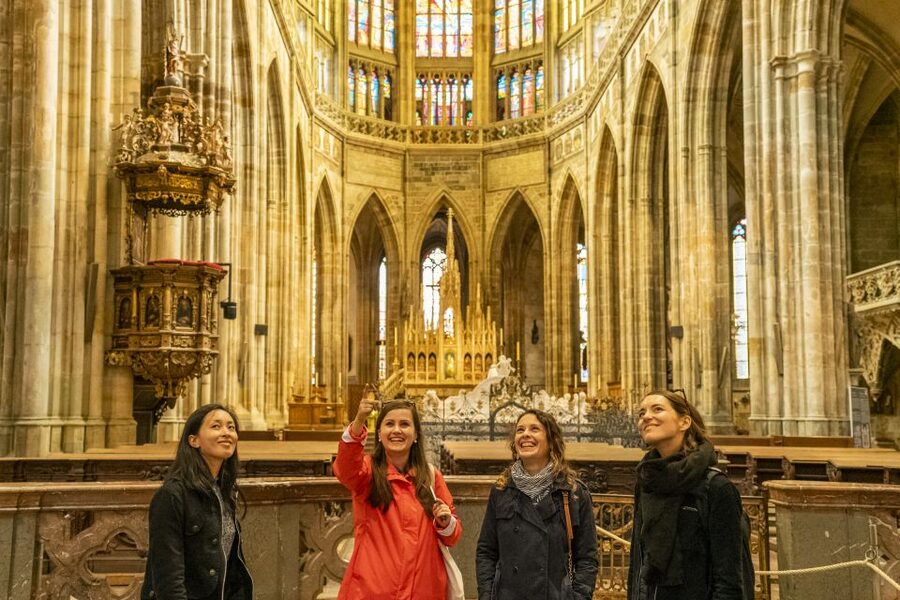
The Old Royal Palace offers a different mood. St. Vitus is about ceremony, faith and monumental architecture. The palace shows the practical side of royal power, including the impressive Vladislav Hall.
The hall’s massive vaulted ceiling is the visual prize. It was built for royal ceremonies, gatherings and events that needed a space larger than a normal chamber. Looking up, you get a clear sense of the ambition behind the medieval and early modern palace.
The most memorable historical stop is the chamber associated with the Defenestration of Prague. In 1618, Czech Protestant aristocrats threw Catholic governors of the Habsburg emperor and their secretary out of a window. That act helped trigger the Thirty Years War, one of Europe’s most destructive conflicts.
The story works well on a guided tour because the room itself may not explain its importance. You need the political background to understand why a window in Prague became connected to a war that spread across much of Europe. The guide supplies that missing link and places the event within the tension between Protestant nobles and Catholic Habsburg rule.
This is also where the tour broadens beyond architecture. You are not only looking at a palace ceiling. You are hearing how religion, power and local resistance collided in the Czech lands.
Same walls, a different way in:
- Prague: 3-Hour Walking Tour of Old Town & Prague Castle
★ 4.7 · 5,696 reviews - Prague: 3-Hour Old Town and Prague Castle Tour in German
★ 4.8 · 5,671 reviews - Prague: Big Bus Hop-on Hop-off, Castle Tour and River Cruise
★ 4.0 · 3,733 reviews - Prague 3-hour Afternoon Walking Tour including Prague Castle
★ 5.0 · 1,899 reviews
St. George’s Basilica and its quieter beauty
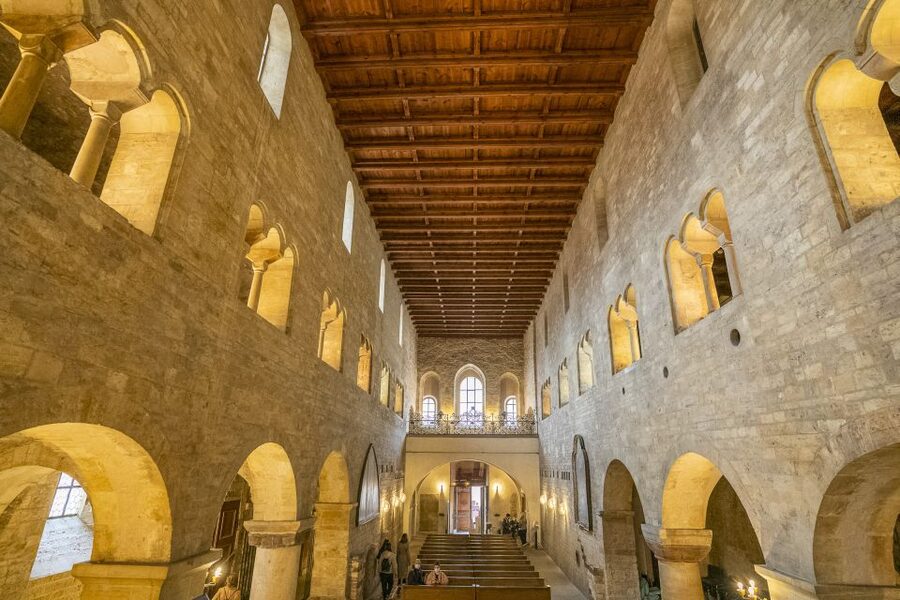
After the scale of the cathedral and palace, St. George’s Basilica feels restrained. Its stone walls and simpler design create a useful contrast. The castle is not all gold, soaring vaults and royal ceremony.
Inside, look for fragments of 12th-century frescoes. They are less flashy than stained glass, but they reward careful attention. The age and partial condition of the paintings give the basilica a different character from the more polished spaces elsewhere in the complex.
The tour also visits the double staircase where the remains of St. Ludmila lie. This is another place where a guide helps. The details are easy to pass without context, especially when you are already processing the cathedral and palace.
I like this stop because it slows the visual pace. The basilica shows that Prague Castle developed over centuries and absorbed different architectural styles. It also keeps the tour from becoming a parade of grand rooms with no change in tone.
Golden Lane and the working people beneath the palace
Golden Lane is one of the most photographed parts of Prague Castle. Its small cottages line a narrow alley, creating a storybook scene that feels far removed from Vladislav Hall.
The original cottages were built for the castle’s sharpshooters. Later, goldsmiths lived and worked there, which explains the lane’s name. In later centuries, artists including Franz Kafka lived in the area.
The reconstructed workshops and homes show how working people lived in the shadow of the castle. The spaces are small, and that is part of the point. After seeing royal halls and church interiors, you get a glimpse of ordinary domestic life.
Golden Lane can be crowded, and its narrow layout leaves little room to stop in the middle. The headphones again prove useful because you can listen while moving through the lane instead of forming a tight circle around the guide.
I would not expect a long, quiet visit here. The route is compact, and you may be sharing it with many other people. Still, it is an important stop because it gives the castle complex a human scale.
What the $61 price includes
At $61 per person, this is not the cheapest way to see Prague Castle. The value depends on how much help you want with transport, entry and interpretation.
The price includes:
- The tram ticket to Prague Castle
- Admission to St. Vitus Cathedral
- Admission to the Old Royal Palace
- Admission to St. George’s Basilica
- Admission to Golden Lane
- A live guide
- Commentary in your selected language
- Headphones
- Use of the short security line
Buying entry and arranging the route yourself may cost less, but you would need to work out the correct ticket, follow the complex layout and supply your own explanation. If you already know Prague Castle well, an independent visit may suit you better. If this is your first visit, the guide saves both planning time and mental effort.
The strongest value comes from the combination of admission and interpretation. The guide does not just point out the building. You get the stories behind the tombs, the political meaning of the palace and the social history of Golden Lane.
The short security line is helpful, but it does not mean every busy day will be free of waiting. Holiday crowds can still create delays, and one winter visit involved long lines and a lot of time in open areas. Think of this feature as a way to reduce one part of the process, not a promise of instant entry.
Timing, weather and the pace of the route
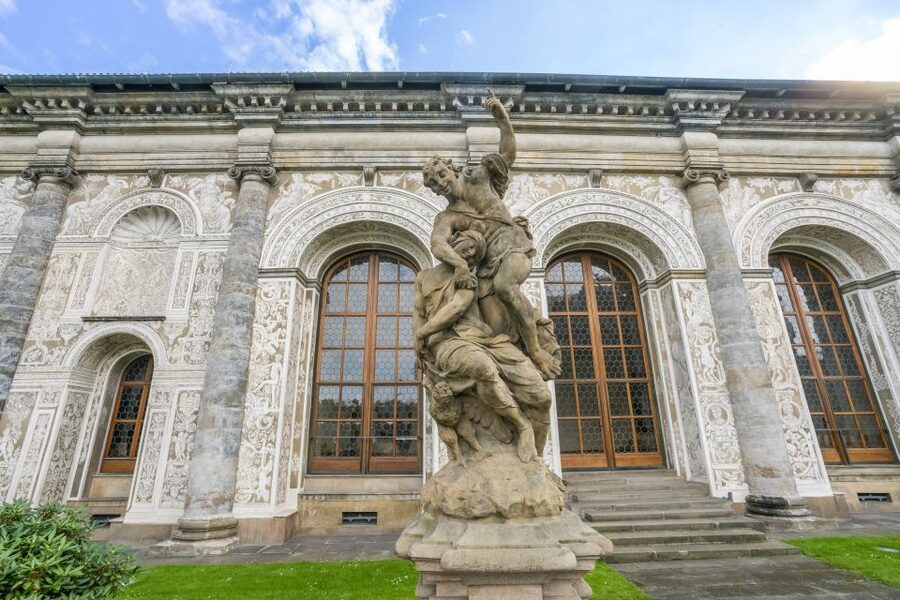
The tour lasts 150 minutes, or two and a half hours. That is long enough to cover the main sights without turning the visit into an all-day march.
The pace appears designed to keep the group moving while allowing time for explanations. One winter tour took place in very cold weather, with temperatures around minus 5 degrees Celsius, yet the guide kept the atmosphere warm and the route moving. You should still wear comfortable shoes and dress for outdoor conditions.
Several parts of the experience take place outside, including movement between buildings and the walk along Golden Lane. Winter can be especially demanding because the open courtyards feel colder and daylight is limited. On the other hand, a cold day may mean fewer people in some areas, though holiday periods can still be packed.
At the end, you can leave the complex, return by tram or continue exploring on your own. The route does not force you to leave immediately once the guided portion ends. That gives you a useful choice: follow the group back, walk down the steps or stay longer if you want another look.
Languages, groups and practical limits
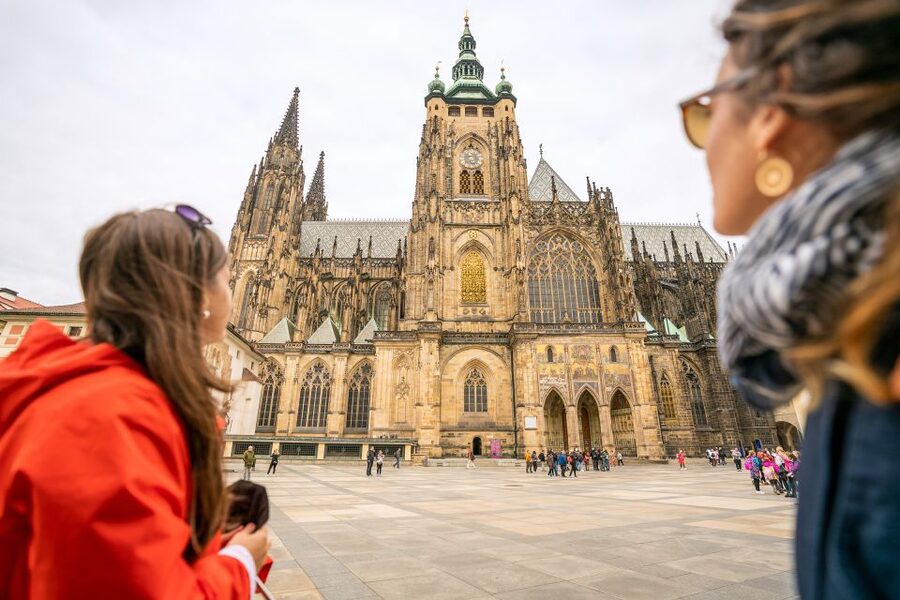
Live guides are available in English, Italian, French, Spanish, German and Russian. Choose carefully when booking, since the guide’s language shapes how comfortable the experience feels.
You can choose a small-group or private format. The private option is the better fit if you want to ask many questions, set your own pace or avoid the uncertainty of a larger group. In the small-group format, audio equipment helps, but group size can still reach 19 people.
The tour can work for people with limited mobility, since one guide was praised for helping less mobile members of the group. Still, the castle complex includes outdoor movement and changing surfaces, so you should consider your own comfort with walking before booking.
Children aged 5 and under go free. Comfortable shoes are the only item specifically required, but warm clothing is a sensible choice in colder months.
Prague Castle can also change its access arrangements at short notice. Official regulations may close certain areas, and no guide can guarantee access to every building on every date. The route is built around the main highlights, but you should keep a little flexibility in your expectations.
Who should book this Prague Castle tour
I would choose this tour if you are visiting Prague for the first time, want the main castle sights in one organized visit or prefer history explained as you go. It is particularly useful if you find large historic complexes confusing or do not want to spend time comparing ticket options.
It is also a good match for people who appreciate a clear narrative. The tour moves from Gothic cathedral to royal palace, then to basilica and working-class lane. That sequence makes the complex easier to understand.
You may prefer to visit independently if you want long periods for photography, dislike fixed schedules or already know the castle’s history. A group tour also means adjusting to other people, even when the guide is good at keeping everyone together.
For most first-time visitors, I think the guide, tram ride, entry ticket and headphones make the $61 reasonable. Book the private option if personal attention matters more than keeping the cost down. For a small-group booking, arrive prepared for a group larger than the phrase small group might suggest.
Should you book it?
Book this Prague Castle tour if you want the essential buildings, a clear historical story and an easier way through a busy complex. The headphones are genuinely useful, and the tram ride saves effort before the walking begins.
Skip it if you strongly prefer exploring alone or want to spend half a day lingering in each room. Otherwise, this is a practical first visit, especially when Ross, Hannah, Anna, Tomáš or Marcela is leading the group. Just bring comfortable shoes, dress for the weather and remember that official closures or large crowds can affect the exact route.
FAQ
How long does the Prague Castle tour last?
The tour lasts 150 minutes, or two and a half hours.
What sights are included in the Prague Castle ticket?
The ticket includes St. Vitus Cathedral, the Old Royal Palace, St. George’s Basilica and Golden Lane.
Is transportation included?
Yes. The tour includes a tram ticket for the journey from the Malostranská area up to Prague Castle.
Where is the meeting point?
Meet directly in front of the exit of Malostranská metro station, near the small water fountain. Look for the brown and white Meeting Point sign and a guide holding an orange umbrella.
How do I find the meeting point from the subway?
After taking the second escalator from the subway, go left.
How do I find the meeting point from the tram?
After getting off at the Malostranská stop, cross the street and walk toward the Malostranská subway stop.
Are headphones provided?
Yes. Headphones are provided so you can hear the guide’s commentary while moving through crowded areas.
What languages are available?
Live guides are available in English, Italian, French, Spanish, German and Russian.
Can I choose a private tour?
Yes. The experience offers either a small-group or private guided option.
Can children join for free?
Children aged 5 and under go free of charge.
Can parts of Prague Castle be closed?
Yes. On rare occasions, official regulations may close some areas at short notice. The guide will do their best to provide a good visit, but access to every building cannot be guaranteed.
Can I cancel the booking?
You can cancel up to 24 hours in advance for a full refund. A reserve now and pay later option is also available.
Newly walked in Prague
- The History of Prague: Prague Castle & Castle District Private Tour★ 5.0 · 21 reviews
- Cesky Krumlov Private day trip from Prague with Lunch and Castle admission★ 5.0 · 49 reviews
- Private Walking Tour: From Charles Bridge to Prague Castle★ 5.0 · 36 reviews
- Prague Fairytale Tour: Old Town And Castle private tour★ 5.0 · 20 reviews
- Prague Walking Tour of Old Town, Charles Bridge and Prague Castle★ 4.5 · 151 reviews
- Prague: Full-Day Old Town, River Cruise & Prague Castle Tour★ 4.8 · 62 reviews
- E-Bike Full-Day Trip From Prague: The Mighty Karlstejn Castle★ 5.0 · 73 reviews
- Saint Vitus Cathedral and Hidden Gems of Prague Castle★ 5.0 · 26 reviews
Castle Entry Tickets, compared.
Edinburgh Castle: Guided Walking Tour with Entry Ticket
Read our review →
Prague Castle 2.5-Hour Tour Including Admission Ticket
Read our review →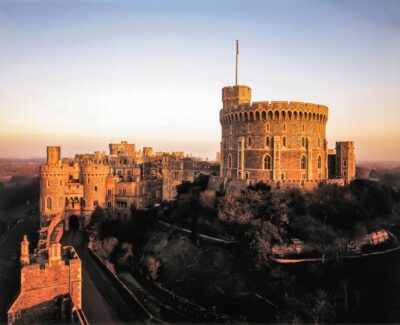
Edinburgh Castle: Guided Walking Tour with Entry Ticket
Read our review →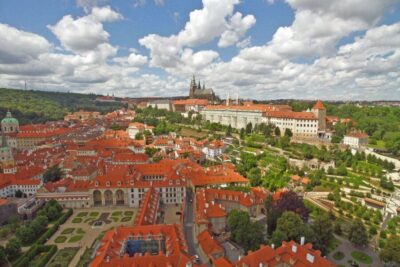
Prague Castle and Lobkowicz Palace Entry Tickets
Read our review →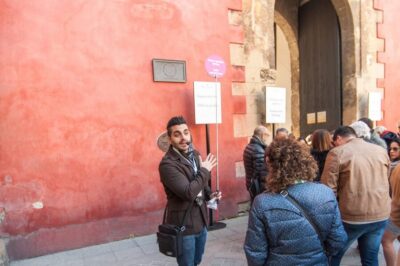
Alcázar and Cathedral Entry Ticket and Guided Tour
Read our review →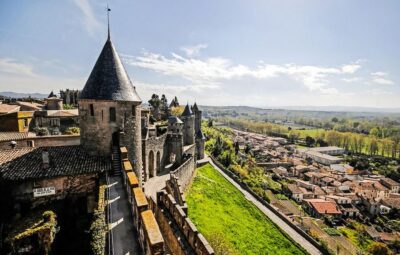
Browse the lists this tour appears in