
Review · SPAIN
Castle of Baños de la Encina
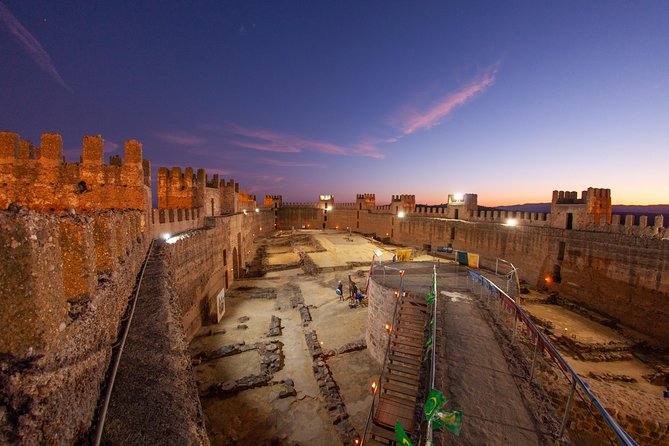
The most striking thing here is the castle itself: a nearly intact Almohad fortress with fourteen crenellated towers, plus a later Christian Tower of Tribute. I like that the tour connects the visible stonework with older finds beneath your feet, including Iberian walls, a funerary mausoleum, and the remains of a 12th-century urban settlement. The setting gives the castle a strong rural silhouette long before you hear the first dates.
I also like the short 45-minute format, which fits neatly into a day exploring Jaén province, and the modest $7.49 price. The guide-led explanation is the real reason to book, since the site’s many building phases could otherwise blur together. The main consideration is timing: 45 minutes gives you a useful introduction, but not an unhurried study of every tower and excavation.
Key points
- Fourteen Almohad towers and one Christian Tower of Tribute create the castle’s unmistakable profile.
- Copper Age, Iberian, Muslim, and Christian layers make this more than a single-period fortress.
- A local guide explains the castle’s change from Muslim to Christian control in a compact 45-minute visit.
- Archaeological excavation remains add depth to the visible walls and towers.
- The $7.49 admission price offers strong value for a guided historic site visit.
- Groups are limited to 25 people, and mobile tickets are accepted at the meeting point.
Why Baños de la Encina Castle deserves your time
Castillo de Baños de la Encina is not just a pretty old fort on a hill. It is a place where several chapters of southern Spain’s past remain visible in one compact site.
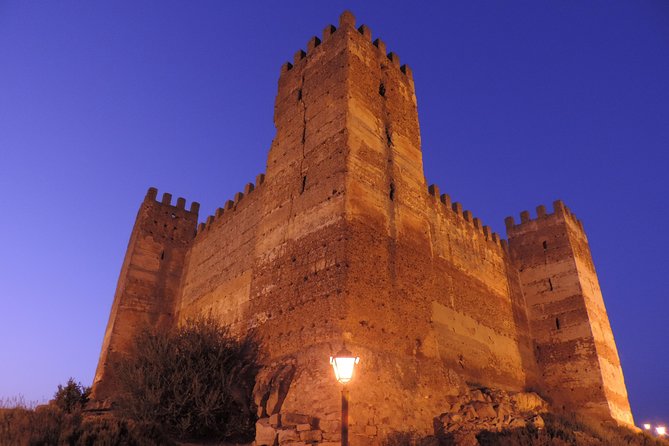
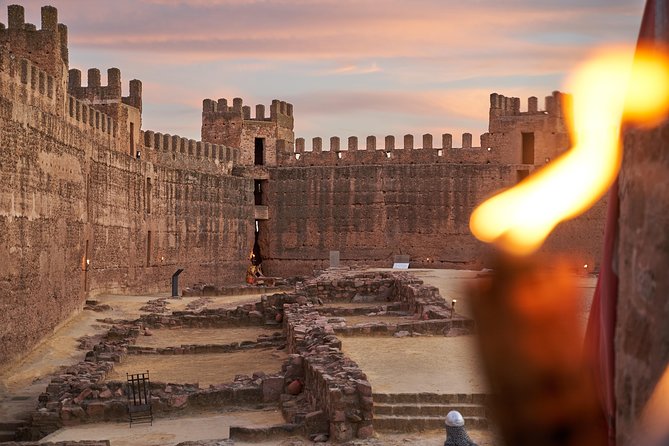
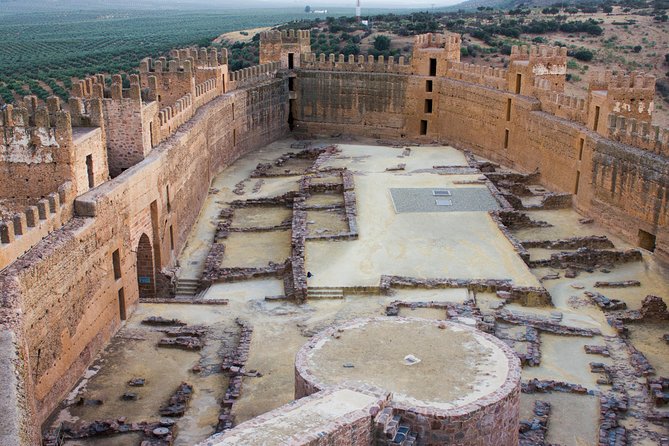
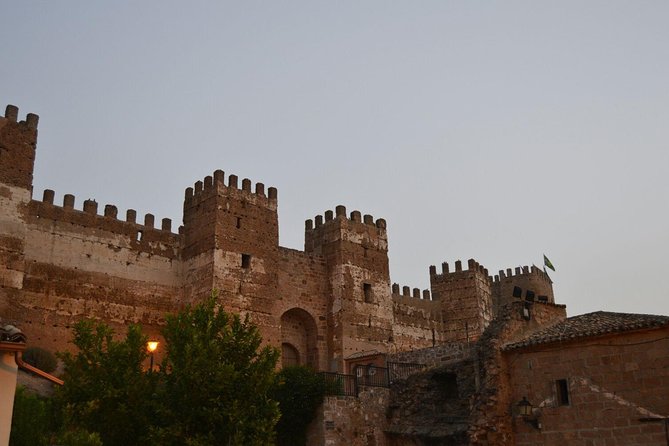
The fortress is known as Bury al-Hamma, and its Almohad construction dates to the 12th century. The castle has suffered little damage, so much of its defensive shape remains easy to read. Fourteen sturdy towers join the crenellated wall, while a fifteenth tower, added under Christian rule, is known as the Tower of Tribute.
I like sites that let you see how power changed hands without needing a long drive between separate monuments. Here, the military design tells one story, the archaeological remains tell another, and the guide helps connect them.
The castle’s position also matters. Its outline dominates the surrounding countryside near Baños de la Encina in Jaén province. You are not entering a restored fantasy built to look old. You are visiting a fortress whose basic form has survived across centuries of conflict and changing rule.
More Castle Tours in Spain:
- Seville: Royal Alcázar Entry Ticket
★ 4.6 · 28,378 reviews - Seville: Alcázar, Cathedral & Giralda Skip-the-Line Tour
★ 4.8 · 11,525 reviews - Seville: Cathedral, Giralda & Alcazar Entry With Guided Tour
★ 4.6 · 8,560 reviews
The 45-minute visit begins with a remarkable fortress
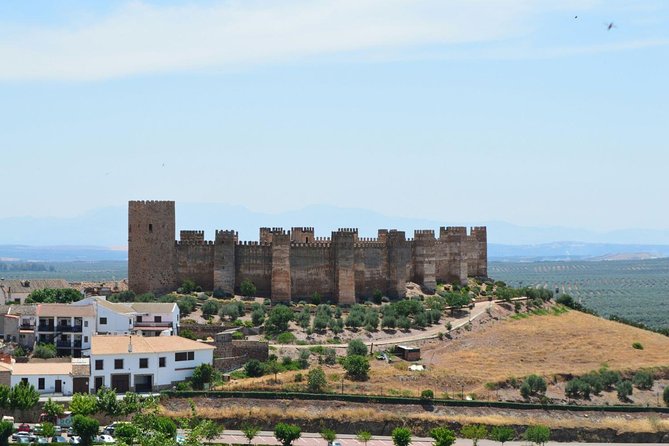
Your meeting point is Castillo de Baños de la Encina, at Calle Santa María, 1, in the town of Baños de la Encina. The activity ends back at the same place, so you do not need to arrange a separate pickup or find your way across town afterward.
Once inside, the first thing to take in is the fortress plan. The walls are reinforced by fourteen towers, each helping explain how the castle was meant to protect the settlement and control movement through the area. The battlements give the building its sharp outline, while the later Christian Tower of Tribute adds a different note to the Muslim defensive design.
A local guide leads the visit and explains the castle from its construction through its loss by the Muslims. No guide’s name is provided for this experience, so you should not book expecting a particular named historian. What you can expect is a guided explanation rather than a simple entry ticket.
That difference matters. Without context, towers can become a blur of stone, dates, and military terms. A guide can point out what belongs to the Almohad period, what changed under Christian rule, and how the excavated material adds evidence beyond the standing walls.
Copper Age traces beneath the fortress
The site reaches much further back than the medieval castle. The earliest known occupation dates to the Copper Age, a prehistoric period that predates the Iberian settlement and the later Islamic fortress.
You will not be visiting a separate prehistoric monument. Instead, the importance lies in the fact that the castle hill was used repeatedly over a very long span. Each period found value in the same strategic ground.
This gives the tour a useful sense of scale. The castle is impressive on its own, but the older remains show that the location mattered before the towers were built. A quick visit cannot explain every prehistoric detail, yet even a short introduction helps you see the fortress as the latest layer of a much older site.
If your interest is limited to medieval architecture, this part may feel brief. If you enjoy archaeology, it is one of the most appealing reasons to choose a guided visit rather than simply photograph the exterior.
Iberian walls and a sacred funerary monument
Inside the castle, strong Iberian walls and a funerary mausoleum of a sacred character add another chapter to the site. These remains belong to an earlier community and help show that the hill was not used only for defense.
The Iberian material is especially useful because it gives you something to compare with the later Almohad construction. The fortress walls were part of a large Islamic military and urban complex, while the Iberian remains point to a different society, different customs, and a much earlier use of the site.
The mausoleum adds a human and religious dimension. It reminds you that ancient occupation was not only about controlling high ground. People also lived, worshipped, and buried their dead here.
The information available for this tour does not specify how much of the mausoleum is visible or how long the guide spends at it. Keep your expectations practical. This is a short castle tour, not a full archaeological field visit. Still, the presence of these remains makes the visit more rewarding for anyone who likes to look beneath the main attraction.
Same walls, a different way in:
- Madrid: Segovia and Toledo Tour, Alcazar, and Cathedral
★ 4.7 · 7,797 reviews - Seville: Priority Access Cathedral, Giralda & Alcázar Tour
★ 4.8 · 7,563 reviews - Madrid: Toledo & Segovia Tour w/ Cathedral, Alcazar & Lunch
★ 4.6 · 5,846 reviews - Córdoba: Jewish Quarter, Mosque, and Alcázar Tour
★ 4.6 · 5,143 reviews
The Almohad urban complex and the castle’s Muslim past
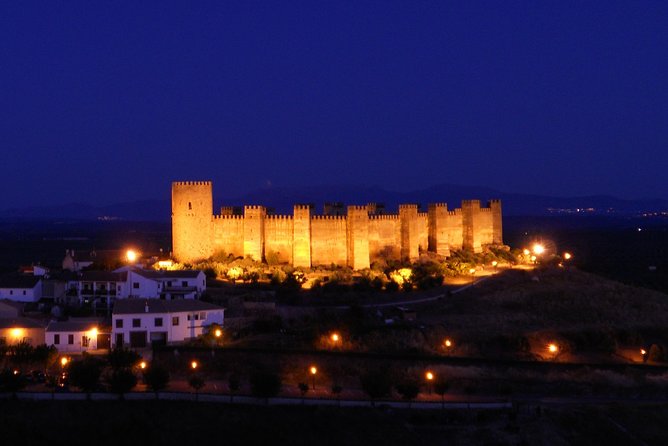
The central story of the visit is the Almohad complex built in the 12th century. The Almohads created the fortress that gives Baños de la Encina its strong profile today, with its crenellated walls and closely spaced towers.
The tour explains the castle’s history from its construction to the point when Muslim control was lost. That transition is important because the building did not simply disappear when political control changed. Instead, later Christian rulers adapted the fortress, including the addition of the Tower of Tribute.
I like this kind of explanation because it avoids treating the castle as a frozen Muslim monument or a purely Christian one. Its present form reflects both periods. The fourteen Almohad towers are the clearest reminder of the original fortress, while the Christian tower shows how later rulers made the site their own.
The exact events and dates of the transfer are not provided in the tour details, so the guide’s explanation will be your main source for that part of the story. If you want a long military lecture, 45 minutes may feel too short. If you want a clear introduction while standing inside the actual structure, the format makes sense.
Archaeology gives the stone walls more meaning
Recent excavation has revealed archaeological remains within the castle. This is one of the strongest features of the experience because it gives you more than the familiar view of towers and battlements.
Standing walls show what survived. Excavation can show how people used the space, what earlier structures lay below, and how the site changed over time. The available details do not list every object or excavation area, so I would avoid arriving with a fixed picture of a large museum-style display.
Instead, think of the archaeological material as an added layer to the guided explanation. The guide can connect what was found underground with what remains above it. That connection helps you understand why the castle matters as an archaeological site, not only as a photogenic building.
The excavation also makes the short tour feel more substantial. You are not paying simply to enter a fortification and walk along a wall. You are getting an introduction to a place with prehistoric, Iberian, Islamic, and Christian remains.
What the $7.49 price really buys you
At $7.49 per person, this is an inexpensive guided experience. The price includes admission, and the tour lasts about 45 minutes. For a historic site with several periods to explain, that is good value.
The key point is that you are paying for interpretation as much as access. If you only want an exterior photograph, you may not need this activity. But if you want to understand why the castle has fourteen Almohad towers, where the Christian tower fits in, and what the excavations reveal, the small fee is easy to justify.
The compact length also helps with planning. You can fit the visit into a day of sightseeing around Baños de la Encina without surrendering half a day. It may also work well before or after a meal or another stop in Jaén province, although no transport or additional stops are included.
The tradeoff is depth. A 45-minute guided visit cannot cover every architectural detail at a slow pace. You may leave with a clear overview rather than a specialist’s knowledge of each tower. For most people, that is a fair exchange at this price.
Group size, mobile tickets, and the meeting point
The group is capped at 25 people. That is large enough to create a normal guided-tour feel but small enough that the guide should be able to address the group without the visit becoming a mass procession.
A smaller group can also help when you are looking at archaeological remains or listening inside enclosed parts of the fortress. The actual group may be smaller, but that is not guaranteed. One particularly favorable visit had a reduced group and pleasant weather, conditions that made the explanation feel more personal and comfortable.
You receive confirmation when booking, and a mobile ticket is accepted. The stated meeting point is the castle itself, at Calle Santa María, 1. Since the activity begins and ends there, check the local time carefully and arrive with enough margin to find the entrance.
Service animals are allowed, and most people can participate. The information does not describe every surface, stair, or interior access point, so anyone with specific mobility needs should confirm details with the provider before booking.
Weather can affect the experience
This activity requires good weather. If poor weather causes a cancellation, you are offered another date or a full refund.
That condition is sensible for a historic fortress visit, where parts of the experience may take place outdoors. It is also worth considering when planning around a tight schedule. A weather cancellation can disrupt a day trip, even though the refund or alternate date protects your payment.
The cancellation policy is generous if your own plans change. You can cancel for a full refund up to 24 hours before the start time. Cancellations or changes made inside the final 24 hours are not refunded or accepted.
For the best chance of a pleasant visit, look at the forecast before your cancellation deadline. The experience is short, so good weather can make a real difference to the comfort of the walk and the quality of the views around the fortress.
Who will enjoy this castle tour most
I would choose this experience if you like military architecture, archaeology, or the layered history of southern Spain. It is also a sensible pick if you want a guided introduction without committing to a long excursion.
Families and mixed-interest groups may appreciate the 45-minute length. The castle offers visual drama, while the guide provides enough history to give the visit purpose. People who prefer a very slow, detailed architectural study may find the schedule too tight.
The tour also suits independent visitors who usually avoid guided activities but want help making sense of a complex site. The low price reduces the risk. You can get the essential story, see the main remains, and continue exploring the area afterward.
This is less suitable if you need transportation from another city, since no transfer is included. You must reach the castle in Baños de la Encina on your own.
Should you book Castle of Baños de la Encina?
Book it if you want to see one of Spain’s best-preserved Muslim fortresses and understand the layers beneath its medieval walls. The combination of fourteen Almohad towers, the Christian Tower of Tribute, Iberian remains, and recent excavation gives the visit more substance than a standard castle walk.
At $7.49, the price is particularly convincing. You get admission and a local guide for 45 minutes, with a group limit of 25 and a mobile ticket for easy entry.
Skip it only if you are looking for a long, highly detailed archaeological tour or need included transportation. For most people already visiting Baños de la Encina, this is a practical, inexpensive way to make the castle’s stones tell a much clearer story.
FAQ
How long does the Castle of Baños de la Encina tour last?
The guided visit lasts approximately 45 minutes.
How much does the tour cost?
The listed price is $7.49 per person, with admission included.
Where does the tour begin?
The meeting point is Castillo de Baños de la Encina, Calle Santa María, 1, 23711 Baños de la Encina, Jaén, Spain.
Where does the tour end?
The activity ends back at the meeting point at the castle.
What does the guide explain?
The guide explains the castle’s history from its construction through the loss of Muslim control, along with archaeological remains found during recent excavation.
What periods are represented at the castle?
The site includes Copper Age occupation, Iberian walls, a funerary mausoleum, a 12th-century Almohad urban complex, and later Christian additions.
Is a mobile ticket accepted?
Yes. The experience includes a mobile ticket.
What is the cancellation policy?
You can cancel at least 24 hours before the start time for a full refund. Cancellations or changes made less than 24 hours before the start time are not refunded. If poor weather causes the activity to be canceled, you will be offered another date or a full refund.
Newly walked in Spain
- Jerez Walking Tour with Alcazar and Cathedral Entrance★ 4.5 · 49 reviews
- Jerez Historic Guided Tour and Alcazar★ 4.0 · 10 reviews
- Barcelona Best Views: Old Town and Montjuic Castle Private Tour★ 5.0 · 24 reviews
- Montjuic Castle Admission Ticket in Barcelona★ 3.5 · 59 reviews
- 2hr Montjuïc Castle Segway Tour★ 5.0 · 5 reviews
- Barcelona City Walk with Montjuïc Castle & Cable Car Guided Tour★ 4.0 · 15 reviews
- Medieval Castles and Girona Exclusive trip with Catalan Lunch★ 5.0 · 3 reviews
- Castle of Montjuic- 3H Segway Tour★ 5.0 · 3 reviews
Spain Castle Tours, compared.


Alcázar, Cathedral & Giralda Skip-the-Line Tour
Read our review →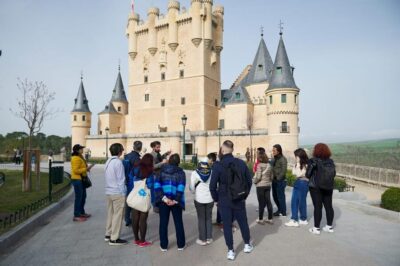
Segovia and Toledo Tour, Alcazar, and Cathedral
Read our review →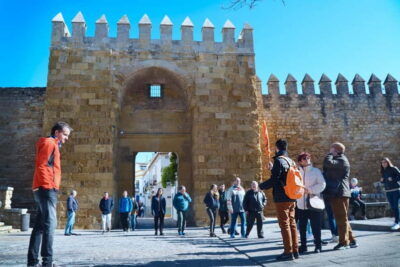
Alcazar and Cathedral of Seville Tour with Skip the Line Tickets
Read our review →
Toledo & Segovia Tour with Cathedral and Alcazar Tickets & Lunch
Read our review →
Alcázar of Seville Skip-the-Line Tickets and Guided Tour
Read our review →
Browse the lists this tour appears in