
Review · BUDAPEST
Buda Castle Walking Tour: A Kingdom of Many Nations
Budapest’s Castle Hill is more than a palace with a fine view. It is an old fortified quarter shaped by Mongol invasion, Renaissance kings, Ottoman rulers, Habsburg emperors, World War II destruction, and postwar rebuilding. This tour gives you a clear way into that complicated story, on foot and with time to notice the narrow streets, painted roofs, courtyards, and small details.
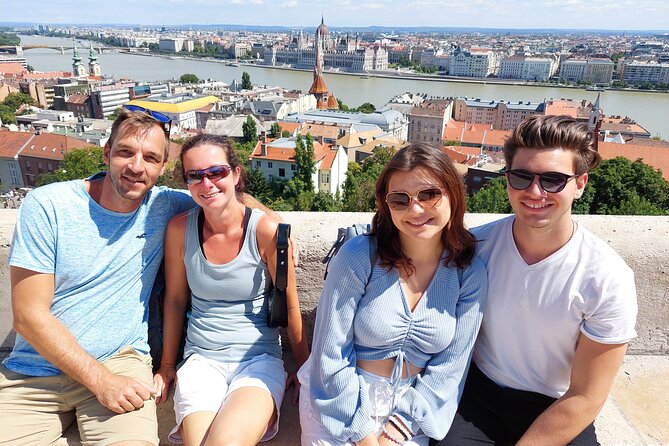
I especially like the small group size, which gives your guide room to adjust the walk to your interests. I also like the human side of the tour. Guides such as Kata, Peter, Gregory, Marianna, and Veronica have been singled out for turning dates and dynasties into stories about real people and daily life. The main consideration is cost: at $126.15 per person, this is not a budget walk, and the admission charges for Matthias Church and Fisherman’s Bastion are separate.
Key Points to Know Before You Book

- Castle Hill is an old town district, not simply one castle interior: Much of the experience takes place outdoors among streets, churches, palaces, and viewpoints.
- The guide is the main reason to choose this tour: Kata, Peter, Gregory, Marianna, and Veronica have all been praised for clear explanations and flexible pacing.
- You get a useful history of Hungary in one morning or afternoon: The route connects medieval, Ottoman, Habsburg, wartime, and modern chapters.
- Matthias Church and Fisherman’s Bastion cost extra: These are key sights, so budget for admission if you want the fullest visit.
- Expect about three hours of walking: Wear comfortable shoes and be ready for cobbled streets and outdoor stops.
- The group is designed to stay small: A booking can include up to six people, while the activity lists a maximum of eight travelers.
Why Castle Hill Makes a Good First History Walk
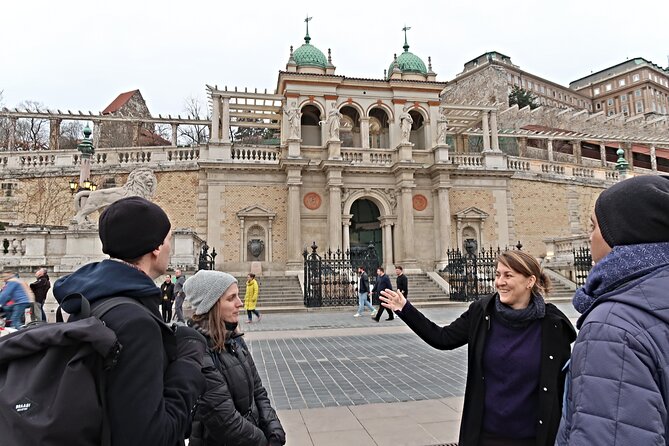
The title, A Kingdom of Many Nations, is a fair description of the route. Castle Hill has changed hands and purpose many times. King Béla IV built a fortress here around 1250 after the Mongol invasion devastated Hungary. Later, King Matthias turned the royal court into one of Europe’s leading Renaissance centers.
Then the Ottoman period brought more than 150 years of Turkish rule. Habsburg emperors followed, and the palace and district were repeatedly altered, damaged, rebuilt, and given new uses. Much of what you see today also reflects reconstruction after World War II, so the hill is a lesson in restoration as much as medieval architecture.
I like this approach because it keeps the tour from becoming a parade of pretty facades. Your guide can explain why a building looks the way it does, who used it, and how its purpose changed. That context matters here. Without it, the Castle District can seem like a polished old quarter with a grand church and a postcard view. With it, the stones begin to tell a longer story.
More Castle Walking Tours in Budapest
- Budapest: Buda Castle Walk with Saint Stephen’s Hall
★ 4.5 · 3,012 reviews - Budapest: Buda Castle District Walking Tour
★ 4.6 · 2,108 reviews - Budapest: 3-Hour Grand City Tour and Castle Walk
★ 4.3 · 1,437 reviews
Starting at the Royal Palace
The walk begins near Országh u. 31, in Budapest’s Castle District. From there, the route spends substantial time around Buda Castle, the enormous palace complex at the southern end of Castle Hill.
Do not expect a standard palace tour with a room-by-room interior visit. The focus is on the exterior, the history of the complex, and the changing role of royal power. The palace was rebuilt, enlarged, burned, altered, and rebuilt again. Its present appearance is largely an eclectic postwar reconstruction, rather than a single untouched medieval building.
This is one of the most useful things to understand before you arrive. The phrase Buda Castle can suggest one preserved royal residence, but the actual site is a layered complex. Your guide discusses how it functioned across different eras and why its appearance changed so often.
The palace portion receives the most time on the route, about two hours within the broader Castle District walk. That does not mean you spend two hours staring at one facade. It indicates that the opening section covers the palace, surrounding streets, historical setting, and other nearby sights before the shorter formal stops.
If you care about Hungarian royal history, military conflict, or how cities rebuild after destruction, this section gives you a useful foundation. If you mainly want an interior palace visit, you should know that this is not the tour’s purpose.
Sándor Palace and the Modern State
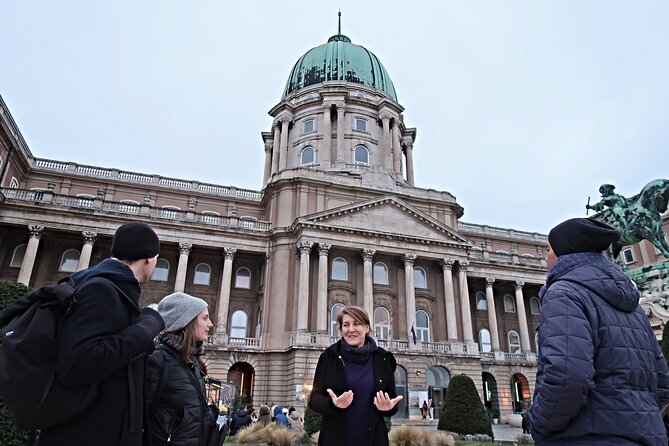
A short stop at Sándor Palace brings the story into present-day Hungary. Built in Neoclassical style in 1806 for Count Vincent Sándor, the palace has served as the official residence of Hungary’s president and the seat of the Office of the President since 2003.
The stop lasts only about five minutes, so do not expect a full visit inside. Its value is the connection between old aristocratic power and the modern Hungarian state. After hearing about kings, pashas, and emperors, you see how this part of Castle Hill still has an official political role.
It is also a useful reminder that the district is not only a museum zone. Government buildings, working streets, religious sites, and homes share the hill. The guide can place Sándor Palace in that wider setting rather than treating it as an isolated photo stop.
Matthias Church, the Architectural High Point

Matthias Church is likely to be the most visually memorable building on the walk. Its roof is covered with colorful patterned tiles, and its tall steeple gives the middle of Castle Hill a strong vertical accent.
Inside, the church is highly decorated and striking. The building you see today is a late nineteenth-century Neo-Gothic reconstruction, so it is important not to mistake it for an untouched medieval interior. Its design is a carefully made historic fantasy, built to suggest earlier periods while reflecting the tastes of its own age.
The church also carries royal importance. It served as a coronation site for Hungarian kings, which gives the visit more weight than its appearance alone. Your guide can connect the building’s religious role with the political ceremonies that took place there.
Admission is not included. The listed visit lasts about 20 minutes, and you should plan to pay the church’s entrance charge separately if you want to go inside. One useful point from the tour experience is that a guide may walk through the church with you, rather than leaving you to admire it without explanation. That can make the extra ticket worthwhile, especially if you want to understand the reconstruction and symbolism.
If your schedule is tight, the church is the stop I would protect. It offers architecture, royal history, and a strong sense of place in a compact visit.
Same walls, a different way in:
- Budapest: Buda Castle Cave Tour
★ 4.7 · 5,677 reviews - Budapest: Buda Castle District Vampires and Myths Night Tour
★ 4.6 · 3,830 reviews - Buda Castle District Dark History, Legends and Vampire Night Tour
★ 4.5 · 1,240 reviews - Budapest: Buda Castle District Walking Tour with a Historian
★ 4.9 · 867 reviews
Fisherman’s Bastion and the Big Budapest View
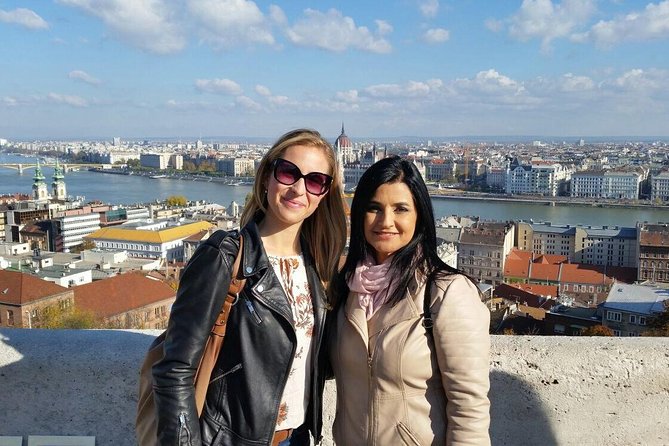
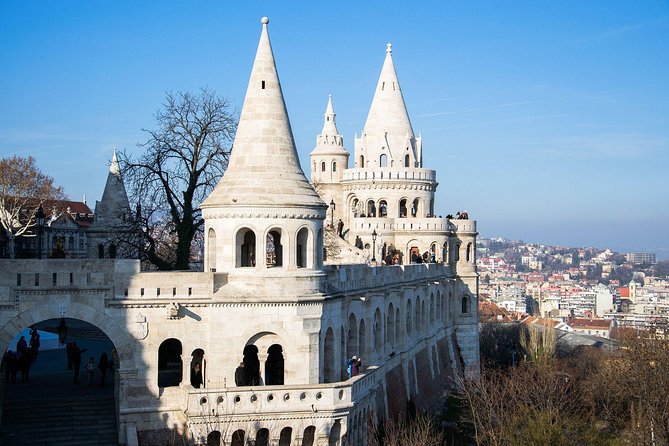
Fisherman’s Bastion is built for photographs, but the guide gives you more than a photo stop. The Neo-Gothic and Neo-Romanesque terraces were designed and built between 1895 and 1902. Their seven towers represent the seven Magyar tribes that settled in the Carpathian Basin at the end of the ninth century.
From the terraces, you can look over the Danube toward Pest, see Margaret Island, and take in Gellért Hill. The view helps you understand Budapest as a city divided and joined by the river. After walking through the enclosed Castle District, this open panorama gives the tour a welcome change of pace.
Fisherman’s Bastion is another place where admission costs extra. Some sections may require a ticket, so include that charge in your planning. The stop lasts about 20 minutes, enough for the guide’s explanation and photographs, but not a long unhurried visit.
The architecture is deliberately theatrical. It is not an ancient fortress in the simple sense, and its towers are not medieval survivors. The guide’s explanation helps you see why this turn-of-the-century structure was made to look older and what its symbols mean.
Finishing at Vienna Gate
The route ends at Vienna Gate, on the northern side of the Castle District. From here, you can look toward Óbuda, or Old Buda, where the Romans founded the city known as Aquincum.
Ending here makes geographic sense. The walk moves from royal power and central monuments toward the older northern side of the hill, then points you toward Budapest’s Roman beginnings. It also gives you a different view from Fisherman’s Bastion, so the tour does not simply finish where it began.
The ending point is in Budapest, but no hotel drop-off is included. You will need to make your own way onward. Since the tour operates near public transportation, that should be manageable, but check your route before setting out if you have a cruise departure, meal booking, or timed attraction afterward.
The Guides Make the Difference

The strongest part of this experience is the guide. The route itself is easy to find independently, but the history is not always easy to organize on your own. A good guide can turn a long list of invasions, rulers, rebuildings, and political changes into a story you can follow.
Kata has been praised for her energy, clear English, patience, and ability to connect Hungarian history with the present. Peter is described as someone who can adapt the walk to your interests and explain details across a large historic area. Gregory has been valued for linking the castle, Budapest, Hungary, and wider world history.
Marianna’s personal stories about life under Soviet occupation add a modern layer that you will not get from medieval monuments alone. Veronica has been especially effective at making the rebuilt Castle District engaging, while Judith has helped visitors with public transportation as well as history.
Other named guides include Runa, Henk, and Susana. The exact guide depends on the date and availability, so you should not book expecting one particular person unless the operator confirms it. The consistent theme is an English-speaking professional who can answer questions and adjust the pace in a small group.
That flexibility matters. A family with Hungarian roots may want more time on national history. Another group may care most about architecture, the Ottoman period, or the wartime destruction of Budapest. A group of four or fewer gives the guide more room to respond than a large coach tour.
Price, Pace, and Practical Value

At $126.15 per person, this is a premium walking tour. You are paying for a professional guide, a small group, and roughly three hours of focused time in one of Budapest’s most important districts. You are not paying for food, hotel transportation, or the main admission tickets.
The value depends on how much guidance you want. If you enjoy reading plaques, following a map, and researching the palace and church yourself, the price may feel high. If you want the complicated story explained in plain English and prefer asking questions as you go, the smaller format can justify the cost.
The tour is offered in the morning or afternoon, depending on the day. That gives you some flexibility when planning Budapest’s other sights. I would choose a time that leaves room for the church and bastion tickets rather than scheduling this too close to another fixed activity.
Plan on a full three hours of walking. Castle Hill has narrow and cobbled streets, and the route includes outdoor viewpoints. Comfortable shoes matter more here than fancy clothes. Food and drinks are not included, so eat beforehand or plan a meal after the walk.
The tour has free cancellation up to 24 hours before the start time. Changes or cancellations inside that window are not refunded, so keep that deadline in mind when arranging your Budapest schedule.
Who Will Get the Most From This Walk
This tour suits you best if you want a historical framework for Budapest rather than a quick photo circuit. It is especially useful early in your stay, since the guide can give you names, dates, and political context that will make later sightseeing easier.
It also works well for people with Hungarian family connections. The tour can help place family stories within the larger history of the country. Visitors who have already taken a general city tour may appreciate this as a more focused look at Buda.
The small format is a good match for couples, families, and people who dislike large groups. The supplied limits are six people per booking and eight travelers for the activity, so confirm the exact group arrangement when booking.
This may not suit you if you want to spend a long time inside the palace or church, or if you prefer a tour with every entrance ticket included. It is also not the best choice for anyone hoping to avoid walking on old streets for several hours.
Should You Book Buda Castle Walking Tour: A Kingdom of Many Nations?
Book it if you want Castle Hill explained by a strong English-speaking guide, especially if history, architecture, and local stories matter to you. The palace complex, Sándor Palace, Matthias Church, Fisherman’s Bastion, and Vienna Gate form a solid three-hour introduction to Buda.
The best reason to choose it is the guide-led storytelling. The tour can show you why the district looks rebuilt, how different powers used it, and why the church and bastion matter. Just budget extra for admissions and remember that Buda Castle means a historic district and palace complex, not a simple interior castle visit.
At $126.15, I would choose this over a cheaper large-group walk if you value conversation and a flexible pace. If you only want the views and photographs, explore independently. If you want Budapest’s complicated past to make sense, this is a worthwhile use of half a day.
FAQ
How long does the Buda Castle walking tour last?
The tour lasts approximately three hours, including the guided walk through the Castle District and stops at the palace, Sándor Palace, Matthias Church, Fisherman’s Bastion, and Vienna Gate.
What language is the tour offered in?
The tour is offered in English with a professional English-speaking guide.
Where does the tour start?
The meeting point is Budapest, Országház u. 31, 1014 Hungary.
Where does the tour end?
The tour ends in Budapest at or near Vienna Gate. Hotel drop-off is not included.
Are admission tickets included?
No. Tickets for Buda Castle, Matthias Church, and Fisherman’s Bastion are listed as not included. You should plan to pay applicable entrance charges separately.
How many people can join the tour?
The booking information allows a maximum of six people per booking. The activity itself lists a maximum of eight travelers.
Is food or drink included?
No. Food and drinks are not included unless specifically stated.
Can I cancel for a full refund?
Yes. You can cancel at least 24 hours before the experience start time for a full refund. Cancellations or changes made less than 24 hours before the start time are not accepted for a refund.
Newly walked in Budapest
- UNESCO Holloko and Eger Castle Private Tour with Transport★ 5.0 · 4 reviews
- True Crime Walking Tour in the Buda Castle district★ 5.0 · 17 reviews
- Private Budapest Sightseeing Tour: Royal Castle, Heroes Square, Chain Bridge★ 5.0 · 4 reviews
- Buda Castle Walking Tour with Audioguide on Your Smartphone★ 4.0 · 24 reviews
- Live virtual walking tour in the Buda Castle quarter★ 5.0 · 10 reviews
- Private Sissi Castle Tour★ 4.5 · 12 reviews
- Private Buda Castle walking tour & Danube river cruise with Margaret Island stop★ 5.0 · 2 reviews
- Private Buda Castle Walk with Entry to Matthias Church★ 4.5 · 8 reviews
Castle Walking Tours, compared.

Edinburgh Castle: Guided Walking Tour with Entry Ticket
Read our review →
3-Hour Walking Tour of Old Town & Prague Castle
Read our review →Edinburgh Castle: Guided Walking Tour with Entry Ticket
Read our review →

Prague 3-hour Afternoon Walking Tour including Prague Castle
Read our review →
Royal Mile and Edinburgh Castle – Small Group Walking Tour
Read our review →
Browse the lists this tour appears in