
Review · BUDAPEST
Buda Castle Tour: History and Architecture
Buda Castle is far more than a grand palace. This 3.5-hour walking tour traces the layers beneath the postcard views, from royal courtyards and Gothic foundations to merchant houses, Jewish ruins, siege walls, and modern buildings fitted around medieval stone.
I like the small maximum of 12 people, which gives the guide room to answer questions. I also like the focus on overlooked details, such as the medieval printing press site on Fortuna Street and the surviving sgraffito decoration on Országház Street. The main limitation is clear: you do not tour the interiors of the Royal Palace or Matthias Church, and the upper terrace of Fisherman’s Bastion costs extra.
Key points to know before you book
- The tour is about Buda’s streets and buildings, not palace rooms: You explore the castle district from outside, with strong attention to archaeology and architecture.
- Máté, also listed as Matthew, leads with visual aids: He uses an iPad with historic images to help you picture buildings that no longer survive.
- The medieval Jewish prayer house is included: This is the only included interior admission, but it is closed on Saturdays and Mondays.
- The route covers far more than the famous sights: You visit Tárnok Street, Úri Street, Fortuna Street, the old Jewish quarter, and siege sites.
- Expect a serious walk: The tour requires moderate fitness and is not suitable for people with limited mobility or children under 10.
- The group is capped at 12: That makes questions and conversation easier than on a large coach tour.
Why this Buda Castle walk feels different
Many first visits to Buda Castle focus on Matthias Church and Fisherman’s Bastion. Those landmarks deserve your time, but they can also make the district feel like a collection of pretty façades and photo stops.
This tour takes a different route through the castle district’s layers. You hear how medieval Buda was organized, where merchants lived, how noble families occupied their houses, and how old Gothic walls were reused in Baroque buildings after war and fire.
The guide connected with the tour is Máté, also referred to as Matthew. His background in history and archaeology shapes the walk. He explains architectural details, answers questions, and uses images on an iPad to show how damaged or vanished structures may once have looked.
That approach matters in Buda. Much of what you see has been destroyed, rebuilt, simplified, or reconstructed. A plain wall may contain medieval foundations. A handsome Neo-Gothic façade may cover the site of older houses. Without context, those layers are easy to miss.
You should also know what this is not. It is not an interior tour of the Royal Palace, Matthias Church, or the upper lookout level of Fisherman’s Bastion. If your main goal is to see museum collections or church interiors, plan extra time after the walk.
More History Inside the Walls in Budapest:
- Buda Castle District Dark History, Legends and Vampire Night Tour
★ 4.5 · 1,240 reviews - Segway Guided Tour In Budapest, Historical Buda Castle
★ 5.0 · 28 reviews - HOLLÓKŐ UNESCO World Heritage site + Eger Castle Private guided tour
★ 4.5 · 18 reviews
Starting at the Royal Palace
The tour begins at the Statue of Prince Eugene of Savoy. From there, the opening stop introduces the Royal Palace, the best-known building on Castle Hill.
The palace began as a medieval stronghold and changed over many centuries. Gothic, Baroque, and Neoclassical influences reflect changing rulers, wars, rebuilding campaigns, and shifting ideas about royal power. The important point is not simply that the palace is old. It is that the building has been repeatedly destroyed and remade.
You spend about 20 minutes here, but the focus is on the exterior and wider setting. The Royal Palace interior is not included. You can visit it independently, but that would be a separate plan and cost.
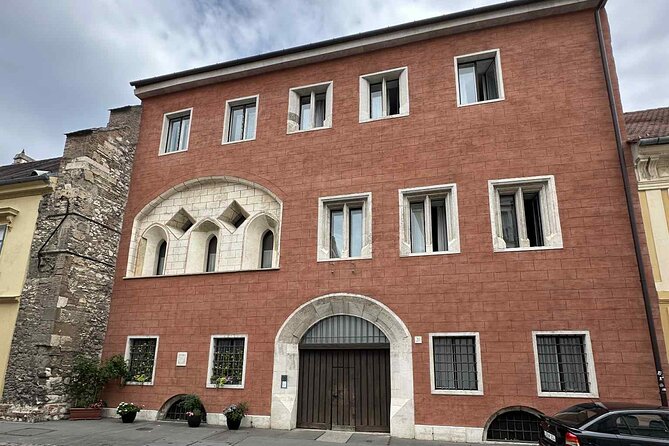
The next stop is brief but worthwhile: the remains of the medieval Sigismund Church. The foundations belong to a Gothic royal chapel built during King Sigismund’s expansion of the palace in the early 15th century. These stones mark the moment when Buda was being shaped into an imperial residence rather than just a fortified royal site.
Merchant houses on Tárnok Street
Tárnok Street offers one of the most useful changes in focus. Instead of royal power, you look at the practical life of Buda’s burghers.
This was the main commercial street below the royal court. Behind its Gothic façades, merchants stored, sold, and displayed goods. The tour examines three surviving buildings with medieval foundations, each shaped by fire, siege, and later city changes.
I like this section because it gives the district a human scale. Royal history can feel remote. A merchant house, a storage space, or a street built for trade helps you picture the people who worked, bought, sold, and lived here.
The stop lasts about 15 minutes. Since it is a walking explanation rather than an interior house tour, you should expect to study façades and street plans from outside. The value comes from learning how to read them.
Noble homes and medieval gateways on Úri Street
Úri Street was the residential quarter of medieval Buda’s upper class. Here, the tour shifts from commerce to status.
Many homes and former palaces sit on 14th and 15th-century foundations. Their thick walls and formal entrances hint at the social divide between the noble quarter and the commercial streets. The finest medieval gateways in the castle district are found here, with arches that once welcomed merchants, craftsmen, and visitors.
This is a good place to pay attention to proportions and stonework. The street may look calm today, but the buildings once expressed rank and wealth. You are not just seeing old doors. You are seeing how an urban elite presented itself.
Like Tárnok Street, Úri Street receives about 15 minutes. The walk is strongest if you enjoy architectural clues and small details. It is less satisfying if you want long interior visits at every stop.
More Castle Tours in Budapest:
- Budapest: Buda Castle Cave Tour
★ 4.7 · 5,677 reviews - Budapest: Buda Castle District Vampires and Myths Night Tour
★ 4.6 · 3,830 reviews - Budapest: Buda Castle Walk with Saint Stephen’s Hall
★ 4.5 · 3,012 reviews - Budapest: Buda Castle District Walking Tour
★ 4.6 · 2,108 reviews
The lonely tower of Saint Mary Magdalene
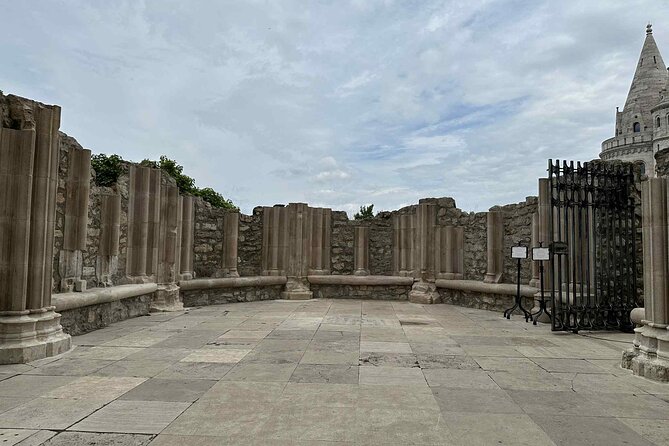
The Church of Saint Mary Magdalene once served Buda’s Hungarian-speaking parish. Its foundations date to the 13th century, making the site one of the earliest church locations on Castle Hill.
The church was partly destroyed during the 1686 siege of Buda. Centuries later, the ruined structure was demolished under Hungary’s communist government in the 1950s. The medieval tower survived through the efforts of archaeologists and preservation workers.
The remaining tower is a useful reminder that historic preservation is not automatic. Political decisions, war damage, and changing ideas about urban planning all affected what remains on the hill.
The stop lasts only about eight minutes, and entry is not included. You will mainly see the exterior and hear the story of the vanished church. That short stop works well within the larger route because it connects medieval religious life with the difficult choices of the 20th century.
Italian merchants and a reconstructed ministry building
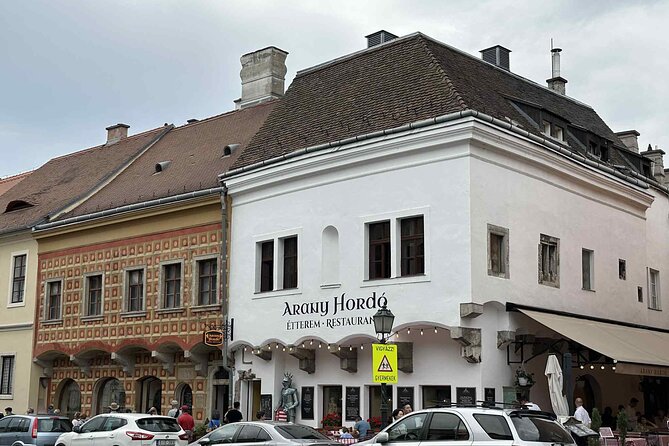
Országház Street was once called Italian Street. Italian merchants lived and worked here, helping make medieval Buda a place of trade and cultural exchange.
One of the details to watch for is the surviving 16th-century sgraffito decoration. It is described as the only surviving example of its kind in the Castle District. Sgraffito uses layers of plaster to create a carved or scratched design, so this small trace of Renaissance decoration is easy to miss without guidance.
The route then reaches the former Royal Hungarian Ministry of Finance. This early 20th-century Neo-Gothic building replaced several medieval structures. World War II caused severe damage, and the postwar façade was simplified.
In recent years, much of the original façade has been reconstructed. The work has also caused debate because part of one original wing was demolished during the project. That tension is worth noting. Historic districts are not frozen scenes. They are places where restoration, reconstruction, memory, and modern needs often collide.
Matthias Church and Fortuna Street
Matthias Church is officially the Church of the Assumption of the Buda Castle. The familiar name is common, but the official title is useful because the building’s story reaches beyond one king. It was originally connected with Buda’s German-speaking community and later changed along with the religious and political life of the district.
The tour pauses outside for about five minutes. Interior admission is not included, so you can return after the walk if you want to see the church inside.
Fortuna Street brings another change in mood. Its modern restaurants sit on a street that once held aristocratic houses and town residences. In the 1470s, German-born printer Andreas Hess produced the Chronica Hungarorum here, regarded as Hungary’s first printed book.
The former Red Hedgehog Inn, known in Hungarian as Vörös Sün, was also nearby. The street once served as a meeting place for merchants, intellectuals, and other members of city life. Today, restaurants occupy the scene, but the earlier world of printing and noble ambition is still part of the street’s identity.
Bécsi Kapu and the National Archives
Bécsi Kapu Square once functioned as a marketplace and one of medieval Buda’s main entrances. It brought together Hungarian townspeople and members of the local Jewish community for trade and daily contact.
The stop is short, about five minutes, but the square helps explain how the castle district worked as an urban community rather than only a royal precinct.
Nearby, the National Archives of Hungary presents a different kind of historical statement. Built in the early 20th century in Neo-Romanesque style, it was designed to fit the medieval character of the district. Stonework and arched windows make the building appear older than it is.
The archives hold documents covering Hungary’s written past. Even from outside, the building links architecture with national memory. It is a useful contrast to the palace: one represents royal power, while the other represents the preservation of records.
Siege walls and the medieval Jewish prayer house
The walk along the outer castle walls brings the story to the Siege of Buda in 1686. The route identifies where Christian allied forces first breached the walls and points toward the place where the Ottoman Pasha of Buda died.
A nearby memorial honors the multinational Christian soldiers who fought and died in the city’s capture. This section gives the castle district a sharper military edge. Fortifications were not just scenic walls. They shaped the fate of the city.
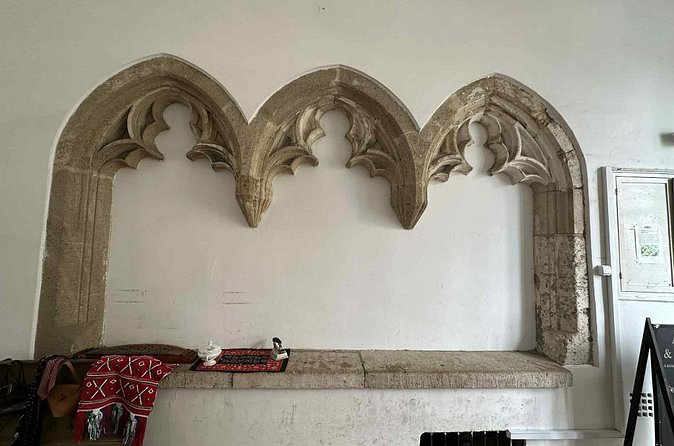
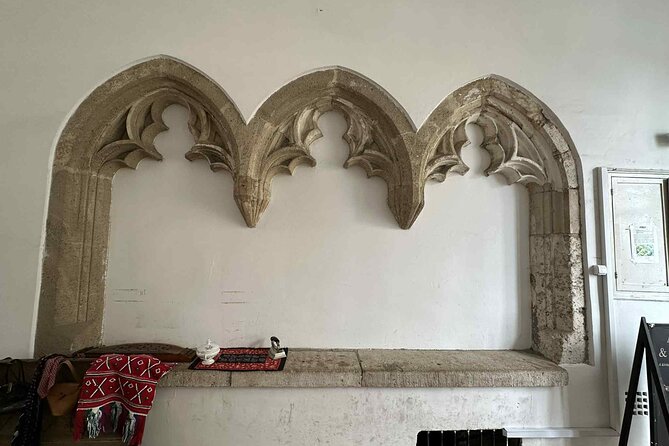
The medieval Jewish quarter follows, and this is one of the most distinctive parts of the tour. You see the site of a former Gothic synagogue and enter an excavated medieval Jewish prayer house.
Admission to the prayer house is included, but it is closed on Saturdays and Mondays. If this site is a main reason for booking, check the day carefully. It offers a rare look at Jewish religious life in medieval Hungary, in a modest space that carries more weight than its size suggests.
This is also the only included interior admission listed for the tour. That fact helps set expectations: the route is mainly an outdoor architectural walk, with one important enclosed site.
Táncsics Street and the Dominican monastery
On Táncsics Mihály Street, you see how later residents reused older structures. Gothic walls and cellars were incorporated into Baroque and later homes instead of being cleared away.
This is one of the clearest examples of Buda’s layered character. The street does not simply show medieval buildings preserved in perfect form. It shows old masonry adapted for new lives after the Ottoman period and the rebuilding that followed.
At Dominikánus Udvar, the ruins of the Dominican monastery of Saint Nicholas recall the religious world of medieval Buda. Friar Julianus, associated with a notable 13th-century journey, belonged to this order.
The ruins later became part of the Hilton Hotel project. Medieval stonework and modern hotel construction now share the same setting. Some visitors will find the contrast striking; others may find it uneasy. Either way, the site raises a practical question that runs through the whole district: how do you protect old remains while allowing a living city to develop?
Finishing at Fisherman’s Bastion
The tour ends at Fisherman’s Bastion and Matthias Church, on Szentháromság Square. Fisherman’s Bastion is one of Budapest’s most photographed landmarks, and the main-level views and architecture are included in the walk.
You do not enter the upper panoramic terrace. That area requires a separate ticket, which you can buy on site if you choose.
The guide also discusses the equestrian statue of King Saint Stephen, Hungary’s first Christian king. The monument ties the final stop to the formation of the Hungarian state, while the bastion provides the familiar visual finish many people expect from a Buda visit.
Ending here is practical. You can continue exploring the square, visit Matthias Church on your own, or make the bastion your final stop for photographs.
Price, pace, and group size
At $43.25 per person, this is a reasonable price if you want a specialist walking tour rather than a quick overview. The fee covers the licensed English-speaking guide and entry to the medieval Jewish prayer house. It does not cover the Royal Palace interior, Matthias Church, Fisherman’s Bastion’s upper terrace, or the Buda Castle Garden Bazaar.
The group limit of 12 improves the value. A guide can respond to questions and point out details without trying to control a large crowd. The tour is also booked well ahead on average, around 44 days in advance, so you should not assume last-minute availability.
The pace is steady and the route lasts about three and a half hours. Wear comfortable shoes and be ready for extended outdoor walking. Moderate physical fitness is required, and the tour is not suitable for people with limited mobility or children under 10.
The English presentation is the only language offered. Confirmation arrives at booking, and the route begins at the Statue of Prince Eugene of Savoy before finishing beside Matthias Church.
Who should book this walk?
I would choose this tour if you want to understand how Buda was built, damaged, rebuilt, and lived in across many centuries. It is especially well suited to you if you enjoy archaeology, architecture, religious history, urban planning, and stories about ordinary city life.
It is also a good match for solo visitors or couples who prefer a small group and a guide who can answer detailed questions. Máté or Matthew brings a strong history and archaeology background, and the use of historic images on an iPad adds useful visual context.
I would look elsewhere if you mainly want museum interiors, a full visit inside the Royal Palace, or a long stop inside Matthias Church. You will need to add those independently.
Should you book the Buda Castle Tour?
Book it if you want the Buda Castle District explained rather than simply photographed. The medieval streets, Jewish prayer house, siege sites, surviving foundations, and reused Gothic walls make this a fuller portrait of the hill than the main monuments alone provide.
Skip it if a long outdoor walk is difficult for you or if paid interiors are your priority. For the right reader, the $43.25 fee buys focused guidance, a small group, and a much clearer sense of how the castle district became the layered place you see today.
FAQ
How long is the Buda Castle Tour?
The tour lasts approximately 3 hours and 30 minutes.
What language is the tour offered in?
The tour is offered in English with an officially licensed English-speaking guide.
Where does the tour begin?
The meeting point is the Statue of Prince Eugene of Savoy in Budapest, 1013 Hungary.
Where does the tour end?
The tour ends at Szentháromság Square beside Matthias Church.
Is admission to the Royal Palace included?
No. The tour discusses the Royal Palace from the outside, but interior admission is not included.
Is admission to Matthias Church included?
No. You may visit the interior independently after the tour.
Is the Fisherman’s Bastion upper terrace included?
No. The tour visits the main level, while the upper panoramic terrace requires a separate ticket.
Is the medieval Jewish prayer house included?
Yes. Entrance is included, but the prayer house is closed on Saturdays and Mondays.
Newly walked in Budapest
- UNESCO Holloko and Eger Castle Private Tour with Transport★ 5.0 · 4 reviews
- True Crime Walking Tour in the Buda Castle district★ 5.0 · 17 reviews
- Private Budapest Sightseeing Tour: Royal Castle, Heroes Square, Chain Bridge★ 5.0 · 4 reviews
- Buda Castle Walking Tour with Audioguide on Your Smartphone★ 4.0 · 24 reviews
- Live virtual walking tour in the Buda Castle quarter★ 5.0 · 10 reviews
- Private Sissi Castle Tour★ 4.5 · 12 reviews
- Private Buda Castle walking tour & Danube river cruise with Margaret Island stop★ 5.0 · 2 reviews
- Private Buda Castle Walk with Entry to Matthias Church★ 4.5 · 8 reviews
Historical Tours, compared.
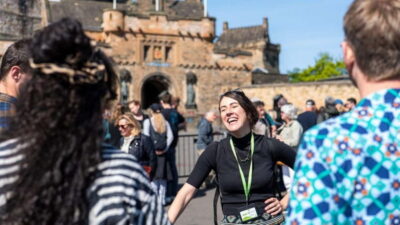
Edinburgh Castle Guided History Tour with Tickets
Read our review →
Charleston historical walking tour with a Professor of History at The Citadel
Read our review →
Buda Castle District Dark History, Legends and Vampire Night Tour
Read our review →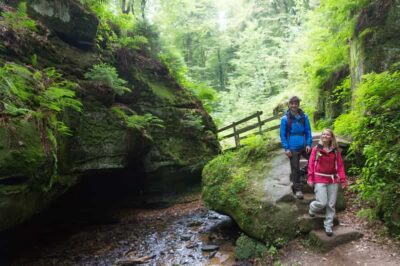
Luxembourg: Nature, History and Castles Full-Day Tour
Read our review →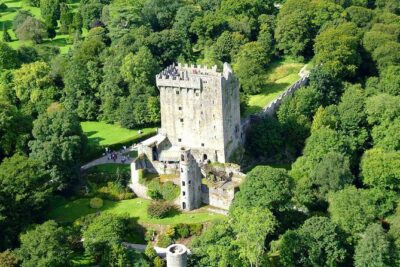
Dublin to Cork, Blarney Castle & Cóbh Heritage Centre by train
Read our review →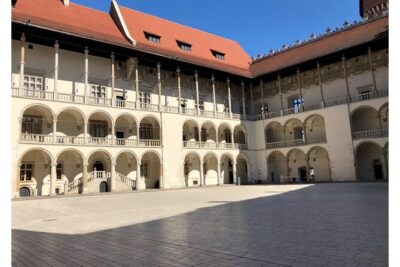

Lake Garda: Historic Castle Cruise with Wine Tasting
Read our review →
Castle History Walking Tour / Castle Tower Admission
Read our review →Browse the lists this tour appears in