
Review · AMMAN
Private Tour: Full-Day Islamic Desert Castles and Ajloun Castle Trip from Amman
Jordan’s desert castles are not grand palaces in the usual sense. They are scattered Umayyad hunting lodges, meeting places, bathhouses, and forts, set across wide, dry plains east of Amman. This private trip links those quiet sites with Ajloun Castle, a very different fortress in the green hills northwest of the capital.
I like the freedom of a private car and the chance to spend more time at places such as Quseir Amra, where faded frescoes show music, hunting, bathing, and a painted zodiac. I also like the range of the day: black basalt at Azraq, early Islamic architecture at Kharaneh, and hilltop military history at Ajloun. The drawback is simple: this is a long day, with roughly ten hours on the road and several stops that are more atmospheric than fully intact.
Key points to know before booking
- Quseir Amra is the artistic highlight: Its small bathhouse contains rare eighth-century frescoes and a zodiac painted on the dome.
- Azraq adds Lawrence of Arabia history: The black basalt fortress was used by T.E. Lawrence during the Arab Revolt.
- Ajloun changes the scenery completely: After the dry eastern plains, you reach a hilltop castle with views over the Jordan Valley.
- You travel privately: Only your own group joins the vehicle, and the route can be adjusted around your interests.
- Named drivers praised for service include Mazen, Hasan, and Amer: They have handled driving, site explanations, water, fruit, and practical advice for later touring.
- Budget for the long day: The listed price is $126.67 per person, with entrance fees and hotel transfers included, while meals, drinks, and tips cost extra.
Why this private route is worth your day
The eastern desert castles receive less attention than Petra, Wadi Rum, and Jerash. That is part of their appeal. You get open country, sparse settlements, old stone buildings, and a clearer sense of how the Umayyad rulers used the area for hunting, rest, administration, and travel.
This is also a useful trip if you want Jordanian history beyond the Roman and Nabataean worlds. The castles date mainly from the seventh and eighth centuries, when the Umayyad dynasty ruled a broad Muslim empire from the Middle East. Their buildings mix practical defense with private pleasure. A fortress might contain a mosque, a bathhouse, meeting rooms, or apartments for visiting officials.
The private format matters here. The sites are spread out, and the drive between them is part of the experience. With your own vehicle, you can ask the driver to slow down for questions, spend longer at a favorite castle, or keep moving if a smaller stop does not hold your interest. The driver is also your main guide unless you choose an option with an additional guide at the desert castles.
Drivers named in the feedback include Mazen, Hasan, and Amer. Mazen was praised for being punctual, patient, polite, and willing to explain Jordanian culture and current life as well as the monuments. Hasan provided site explanations at Qasr Al-Harranah and Quseir Amra, and also offered water, fruit, tea, and suggestions for later touring. Amer was described as a careful driver who also explained the history of the country.
Those details matter on a ten-hour outing. A friendly driver cannot turn every ruin into a major monument, but good company makes the long stretches easier.
More Private Castle Tours in Amman:
Leaving Amman for the eastern desert
Pickup is offered from central Amman at about 9:00 am, with airport pickup or drop-off available by request. The ride takes you away from the capital toward the dry eastern plains. Your air-conditioned vehicle is private, and onboard Wi-Fi is included.
The route is not scenic in the postcard sense. It is broad, spare, and sun-exposed, with the occasional settlement, road traffic, and long views across open ground. Bring a hat, sunscreen, and comfortable walking shoes. The advice is practical, not decorative: several sites have rough surfaces, exposed courtyards, uneven steps, and little shade.
The published stop order can vary by route planning. The main desert stops are Quseir Amra, Qasr Al-Harranah, and Qasr Al-Azraq, followed by Ajloun Castle before the return to Amman. Your driver can explain the day’s sequence at pickup.
Quseir Amra and its remarkable painted bathhouse
Quseir Amra is the stop I would protect time for. It is smaller than many people expect, but its interior decoration gives it unusual importance. Built in the eighth century under the Umayyad caliph Walid II, it served as a hunting palace and bath complex rather than a conventional defensive castle.
Inside, you see faded but striking frescoes. The paintings include hunting scenes, musicians, bathing figures, wine, and female figures shown in a way that feels surprising in an early Islamic setting. The bath chamber has a dome painted with the zodiac, an especially memorable detail because it reveals the builders’ interest in science, leisure, and visual display.
The building has been restored, but you should still expect delicate surfaces and subdued colors rather than bright modern paintings. The small rooms and vaulted spaces reward a slow look. Ask your driver or guide to point out the main scenes, since the meaning of some images is easy to miss when you are moving quickly.
You are allotted about 90 minutes here. That is generous for a compact site, especially if you want photographs and time to study the ceiling. There is not a large complex to explore, so the value comes from attention rather than distance covered.
Qasr Al-Harranah and the puzzle of its purpose
Qasr Al-Harranah, also called Kharaneh, looks more like a castle than Quseir Amra. Its square form, rounded corner towers, thick walls, and central courtyard make it instantly readable as a fortified building. It rises from a broad plain with few distractions, which helps you see its shape clearly.
The building has two levels, rooms around the courtyard, ornamental pilasters, and niches. Its architecture reflects several influences, including Mesopotamian, Arabic, and Greek features. It may have been built on earlier Roman foundations, although its exact role remains uncertain.
That uncertainty is part of the interest. It may have served as a fortress, a meeting place, a caravan stop, or accommodation for officials. It was probably not a castle in the romantic European sense. Think of it as a multipurpose Umayyad station, designed for people, goods, and official business as much as for war.
The rooms are plain compared with Quseir Amra, but Kharaneh gives you a better sense of scale and defensive planning. Walk around the courtyard and look up at the repeated forms of the towers and walls. The site is exposed, so your hat and water matter.
A local guide may be available at the desert castles, depending on the option you book. One practical caution comes from the site experience: local guides can sometimes occupy central viewpoints or seem abrupt with independent visitors. A private driver who knows how to handle the stops can help you get the explanation you want without losing your patience.
More Castle Day Trips in Amman:
- One Day Trip to Jerash & Ajloun Castle
★ 5.0 · 57 reviews - 6 Day Tour: Amman Petra Jerash Baptism Site Karak Castle Wadi Rum Red & Dead Sea
★ 5.0 · 32 reviews - Day Tour to Jerash, Ajloun Castle and Dead Sea
★ 5.0 · 31 reviews - From Amman: Full-Day tour Amman city tour and desert castles
★ 5.0 · 23 reviews
Qasr Al-Azraq and Lawrence of Arabia
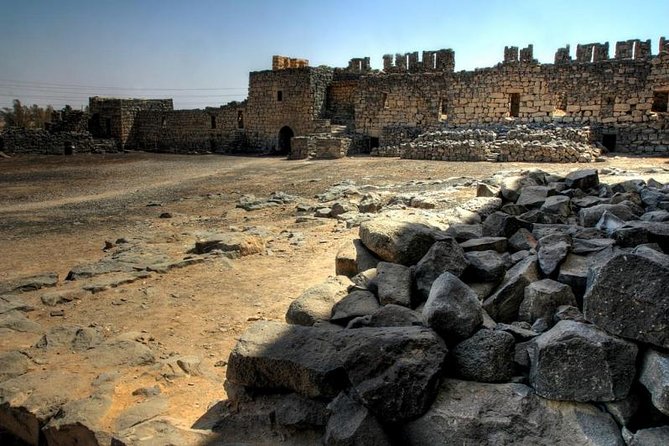
Azraq is built from dark basalt, making it visually different from the pale stone of the other eastern castles. The fortress grew around the Al-Azraq oasis, a valuable water source in an otherwise dry region. Its heavy blocks, arches, towers, courtyard, and mosque create a darker, more severe mood.
The site began as an Umayyad hunting retreat and later served changing military purposes. Its best-known modern connection is T.E. Lawrence, the British officer and Arab Revolt leader often called Lawrence of Arabia. He used Azraq as a base during 1917 and 1918.
The Lawrence connection adds a human story, but it should not be the only reason you come. The older structure is the main attraction. Look at the massive stonework, the way entrances were controlled, and the fortress’s relationship with the oasis. The basalt gives the place a strong sense of permanence, even where walls and rooms have fallen away.
Azraq is also a reminder that water shaped movement through this part of Jordan. The castle was not placed randomly in the desert. Its position near the oasis helped make it useful to rulers, soldiers, hunters, and passing officials.
Allow around 90 minutes for this stop. Some visitors may find the desert castles less impressive than expected because they are partly ruined and sparsely furnished. Azraq is best appreciated as a place of setting, material, and military history rather than as a fully restored palace.
Ajloun Castle brings a different Jordan into view
After the desert sites, the journey to Ajloun changes the tone of the day. Ajloun Castle, also known as Qala’at ar-Rabad, is a twelfth-century fortress built during the time of Saladin to help defend against Crusader armies.
The castle sits on a hill, and its towers look across the greener hills of the Jordan Valley. This setting alone makes Ajloun a strong final stop. After hours of dry plains and low ruins, you get height, trees, and long views.
Inside, expect corridors, staircases, chambers, towers, and defensive details. The fortress is partly intact, so it is easier to picture as a working military building than some of the desert sites. Look for the openings called murder holes, through which defenders could drop hot oil or pitch on attackers below.
The published timing gives four hours to the Ajloun portion, which includes the long transfer from the eastern castles and the return toward Amman. Do not read that as four hours inside the fortress. The total day lasts about ten hours, and the drive is a major part of it.
Ajloun suits people who like to walk through ruins rather than simply view them from outside. Stairs and uneven surfaces are part of the visit. If you have mobility concerns, contact the operator before booking so the day can be discussed.
What the $126.67 price includes
At $126.67 per person, the price is easiest to judge by group size. For one person, it is not a budget day out. For two or more people, private transport, hotel pickup and drop-off, an English-speaking driver, Wi-Fi, and entrance fees make the cost more reasonable.
You are paying for convenience as much as admission. Reaching three eastern castles and Ajloun independently would require arranging transport across a large part of Jordan, checking routes, and managing several ticket points. Here, the car and driver stay with you throughout the day.
Entrance fees are included if you choose the option with them. Jordan Pass holders should tell the operator, since entrance fees can be reimbursed at the destination. Arab and Gulf Cooperation Council passport holders are advised to choose the Jordan Pass option or pay reduced entrance fees directly, rather than automatically paying for full admission.
Lunch is not included unless you select the lunch option. Drinks are also excluded. A vegetarian meal can be requested, and local restaurants may not serve alcohol. If that matters to you, ask about the lunch setting before departure.
Tips and personal expenses are extra. Tipping the driver is recommended, especially if the driver handles both the long route and site explanations.
Who should book this day trip?
I would recommend it to you if you have already seen Amman’s main sights and want a quieter, less familiar side of Jordan. It works especially well for history fans who enjoy comparing buildings with different purposes: bathhouse and hunting lodge at Amra, multipurpose fortress at Kharaneh, oasis stronghold at Azraq, and Crusader-era castle at Ajloun.
It also suits solo visitors who want a private setting and a driver who can help with timing and local questions. Mazen was specifically praised for his respectful manner with a solo woman, while Hasan and Amer were also described as helpful and professional.
I would hesitate if you dislike long drives, hot open sites, or partially ruined buildings. The desert castles are not five large, polished attractions. Their interest lies in small details, unusual decoration, architectural questions, and the contrast between the eastern plains and Ajloun’s hills.
The cancellation policy allows a full refund up to 24 hours before the experience. Confirm pickup with the operator a day ahead, particularly if your hotel is outside central Amman.
Should you book the Islamic desert castles and Ajloun tour?
Book it if you want variety and private transport more than a relaxed pace. Quseir Amra is the artistic prize, Azraq supplies the Lawrence connection and black basalt walls, Kharaneh shows early Islamic design, and Ajloun provides the most substantial fortress and the best views.
Skip it if your Jordan schedule is already packed or if ten hours in a car sounds exhausting. For the right person, though, this is a useful counterpoint to Petra and Wadi Rum. It shows a quieter Jordan of oases, hunting lodges, military roads, and castles that are easy to pass by unless you make a special effort to reach them.
FAQ
How long does the tour last?
The experience lasts approximately 10 hours, including the drives between Amman, the desert castles, Ajloun Castle, and the return to Amman.
What time does pickup begin?
The stated start time is 9:00 am. Hotel pickup is offered from central Amman.
Is transportation private?
Yes. Only your group participates, and transport is provided in a private air-conditioned vehicle suited to the number of participants.
Is an English-speaking guide included?
An English-speaking driver is included, and the driver also acts as your guide. An additional guide at the desert castles is available if you select that option.
Which entrance fees are included?
Entrance fees for Al-Azraq, Quseir Amra, Al-Kharaneh, and Ajloun Castle are included when you select the option with entrance fees. Jordan Pass holders should notify the operator for reimbursement at the destination.
Is lunch included?
Lunch is not included unless you select the lunch option. Vegetarian meals can be requested, and beverages are not included.
Can airport pickup or drop-off be arranged?
Yes. Airport pickup and drop-off are available by request.
What should I bring?
Bring a hat, sunscreen, and comfortable walking shoes. The sites include exposed areas, uneven ground, corridors, and staircases.
More Full-Day Trips in Amman
- 5-Desert Castles of Jordan Full-Day Private Tour from Amman
★ 4.5 · 11 reviews - Private Full Day Crusader Castles of Karak & Shobak, Kings Highway from Amman
★ 5.0 · 9 reviews - From Amman: Full-Day Tour to Amman City and Desert Castles
★ 5.0 · 7 reviews - Jerash and Ajloun Castle Full-Day Tour from Amman or Airport
★ 5.0 · 6 reviews
Newly walked in Amman
- Umm Qais, Jerash & Ajloun Castle Day Tour from Amman★ 5.0 · 6 reviews
- Private Tour of Desert Castles Eastern Jordan with optional Azraq Wetland Visit★ 4.5 · 21 reviews
- Private Tour Petra and Shobak Castle from Amman★ 5.0 · 5 reviews
- Private Full Day Crusader Castles of Karak & Shobak, Kings Highway from Amman★ 5.0 · 9 reviews
- Day Trip to Petra, Wadi Rum, and Shobak Castle★ 5.0 · 9 reviews
- Jerash Umm Qais & Ajloun Castle Tour★ 5.0 · 2 reviews
- Private Trip : Amman Jerash and Ajloun Castle★ 5.0 · 4 reviews
- Jerash and Ajloun Castle Full-Day Tour from Amman or Airport★ 5.0 · 6 reviews
Castle Day Trips, compared.
Neuschwanstein & Linderhof Castle Full-Day Trip
Read our review →
Neuschwanstein & Linderhof Castle-Fairytale Day Tour from Munich
Read our review →
Dracula’s Castle, Peleș Castle & Brașov Day Trip
Read our review →
Windsor Castle, Stonehenge, and Oxford Day Trip from London
Read our review →
Isle of Skye and Eilean Donan Castle Day Trip
Read our review →
Loire Valley Castles Day Trip from Paris with Complementary Wine
Read our review →
Windsor Castle, Stonehenge & Bath Full-Day Tour
Read our review →
Day Trip to Dracula Castle, Peles Castle & Brașov
Read our review →Browse the lists this tour appears in