
Review · OSAKA
Osaka: Castle History Walking Tour / Castle Tower Admission
Osaka Castle makes far more sense when you see it as a military machine, not just a pretty tower. This 90-minute walk explains how moats, stone walls, angled gates, zigzag paths, arrow slits, and gun ports worked together to slow an attacking army. The story ends with the castle’s fall during the battles of 1614 and 1615.
I like the tour’s focus on details you could easily miss alone, especially the castle’s largest stone and the hidden marks left by stonecutters. I also like the separate entrance for castle admission, since several bookings report that this saved time when the regular line grew long.
The main consideration is pace. You walk through outdoor historical sites before entering the tower, and the castle museum itself is not guided floor by floor. You get the big picture and expert context, then explore the interior displays on your own.
Key points at a glance

- The defenses become easy to read: Triple moats, layered gates, and masugata entrances show how attackers were delayed and divided.
- The largest stone is a real highlight: You learn how builders moved enormous stones in the 16th century.
- The route includes Hokoku Shrine: This adds a cultural stop tied to Toyotomi Hideyoshi and Osaka’s past.
- The tower visit ends with city views: The guide takes you through the main approach, then you can look around the castle interior independently.
- English-speaking guides bring different strengths: Saya, Mao, Spike, Yuta, Kaz, Ken, and others are praised for clear explanations, warmth, and patience.
- Morning can be smart: A 9 a.m. start may help you reach the tower before lines grow later in the morning.
Why Osaka Castle is better with a military story
The reconstructed tower is easy to admire from a distance. Its white walls, green rooflines, and gold details make it one of Osaka’s most recognizable sights. But the tower is only the final piece of the experience.
The more interesting question is how an army would have reached it. This tour answers that by beginning outside the main building, where the castle’s real strength becomes visible. You follow the approach through defensive layers designed to delay, confuse, and expose attackers.
I like this approach because it changes the way you look at the grounds. A wall is no longer just a wall. A gate is not simply an entrance. Every turn had a job.
The guide explains how attackers were forced into narrow routes and sharp changes of direction. Soldiers defending the castle could fire down on them while the attackers struggled to keep formation. The route was meant to break an army into smaller groups and make progress painfully slow.
That practical focus suits Osaka Castle. You do not need a detailed background in Japanese history or military architecture to follow the tour. The guide builds the story from what you can see in front of you.
More Castle Walking Tours in Japan
- Tokyo Castle & Imperial PalaceーShogun Walking Tour
★ 4.7 · 1,068 reviews - Ultimate Osaka Walking Tour: Castle, Dotonbori & Hidden Gems
★ 5.0 · 862 reviews - Tokyo Castle & Imperial PalaceーShogun Walking Tour
★ 5.0 · 724 reviews
Meeting at Lawson S Otemae Rest House Store
The meeting point is in front of Lawson S Otemae Rest House Store. This detail matters because there are several Lawson convenience stores in the Osaka Castle area. Check the supplied Google Maps location carefully before setting out, and look for the Local Guide Stars sign.
Once the group is together, the walk heads toward the castle grounds. Bring comfortable shoes, since the tour involves outdoor walking over a large historic site. Weather-appropriate clothing is also important because much of the explanation takes place outside.
The advertised duration is 90 minutes. The route information also lists a 75-minute guided castle segment, a 20-minute guided stop at Hokoku Shrine, and a further castle visit with photo and self-guided time. Those listed portions suggest that timing can vary by group and by crowd conditions, so keep a little flexibility around the booking.
Triple moats and the long road to the tower
The first major lesson is that Osaka Castle was not protected by one wall alone. The approach used triple moats and multiple defense layers, forcing an attacker to cross one obstacle after another.
The guide points out how the walls and gates worked as a connected system. A moat slowed movement. A gate narrowed the route. Another wall or turn created a fresh delay. The result was a long approach where defenders could watch, target, and separate the people trying to break through.
The masugata entrance is one of the most useful features to understand. Its name refers to a square-shaped gate area. Rather than opening straight into the castle, the route turns inside a confined space. An attacking force could enter, but it could not simply continue forward in a clean line.
I find this one of the strongest parts of the walk because the design is visible. You do not have to rely on a museum diagram. You stand in the turns and see how a large force would have struggled to move through them.
The guide also discusses the zigzagging routes that once placed attackers under fire. From the defender’s point of view, the turns offered chances to attack from different directions. From the attacker’s point of view, each turn removed momentum and made the next target uncertain.
Stone walls that discouraged climbing
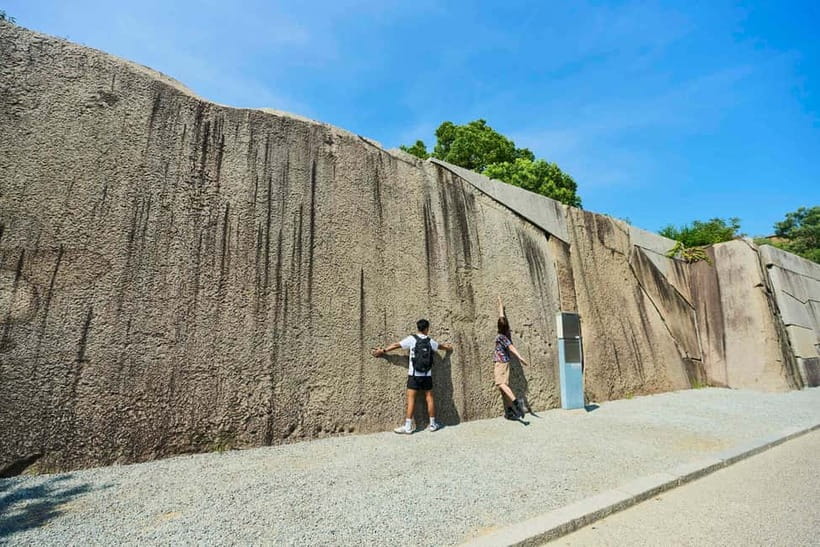
The castle’s stonework gets careful attention. You learn why the walls were angled and how their construction made them difficult to climb. The broad lower sections and carefully placed stones were not only impressive displays of labor. They were defensive tools.
Look for marks on the stones as you walk. Master craftsmen and different groups of workers left identifying signs, and a guide can help you notice them. Without that explanation, these marks may look like random scratches or weathering.
The tour also introduces the largest stone in the castle. Its size raises a practical question: how did builders move such a massive block in the 16th century, long before modern cranes and trucks?
The answer is presented through historical transport methods and the labor needed to position heavy stones. This is a good moment to pause and think about the project as an engineering effort. The walls were not assembled from small, convenient blocks. Large stones had to be selected, hauled, lifted, and fitted into place.
That story gives the castle a human scale. You begin to picture the workers, planners, and craftsmen behind the fortress, rather than seeing only a finished monument.
More Castle Walking Tours in Osaka
- Osaka Castle Walking Tour and Castle Tower Admission
★ 5.0 · 561 reviews - Osaka Highlights: 4-Hour Walking Tour with Castle
★ 5.0 · 152 reviews
Hokoku Shrine and the Toyotomi connection
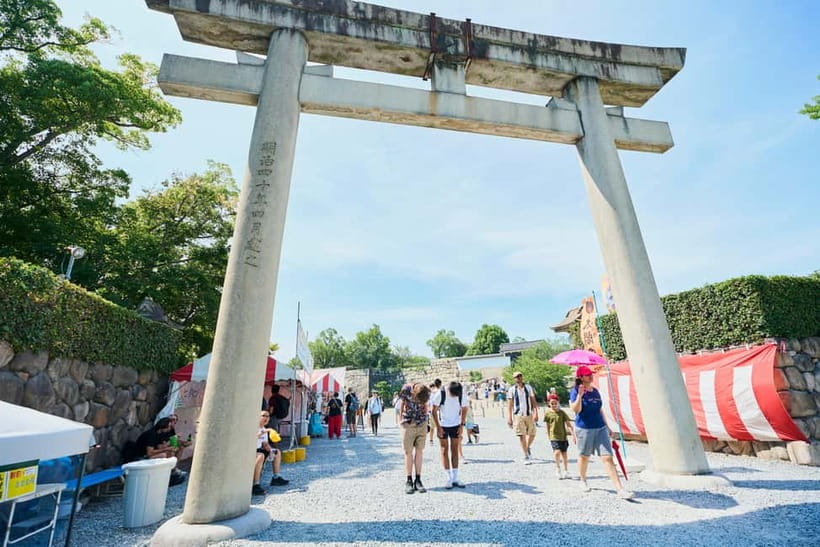
The route includes Hokoku Shrine, a stop that connects the castle grounds to Toyotomi Hideyoshi. The tour uses the shrine to place Osaka Castle within the larger story of power, ambition, and memory in Japan.
This is a shorter stop than the main castle walk, but it adds useful context. The castle was closely tied to Hideyoshi’s rise and to the political struggle that followed his death. The eventual conflict was not simply a battle over a building. It was a fight over who would control Japan and whose legacy would survive.
One booking happened to encounter a traditional Japanese wedding ceremony at the shrine. That kind of event is not guaranteed, but it shows why the shrine can feel like more than a history lesson. It remains a functioning cultural place, not just a backdrop for photographs.
I would treat this stop as a welcome change of pace. After studying moats, gates, and walls, the shrine adds a more personal and cultural side to the story.
The tower as command post and final defense
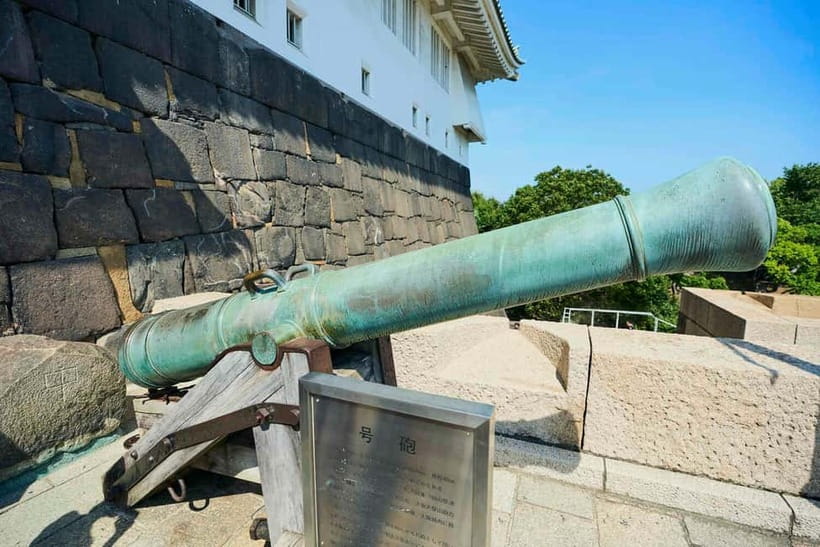
The guide then brings the military story back to the tower. You learn to look for arrow slits and gun ports, features that helped defenders protect the castle from above and from behind fortified walls.
The tower also served as a command post and a last line of defense. Its height gave leaders a better view across the surrounding area, while its position deep inside the castle made it harder for attackers to reach.
Gold had a practical psychological role as well as a decorative one. The shining surfaces helped display power and wealth. A fortress that looked rich and imposing could make an enemy think twice, especially when paired with thick walls and difficult approaches.
The included ticket takes you into Osaka Castle Tower. The guide’s main work is the route and the story, not a floor-by-floor explanation of the museum. Once inside, you should expect some self-guided time to examine the displays and continue upward.
The city view from the top is the reward for the outdoor walk and long approach. It gives you a clear sense of the castle’s position within Osaka, and it helps tie the defensive story to the modern city around it.
Several bookings describe the route ending near the top of the castle, leaving time to look around independently. That arrangement works well if you prefer a guided introduction followed by freedom to move at your own speed.
How an invincible castle fell in 1614 and 1615
The final historical question is the most important one: how did a fortress designed to be so difficult to attack eventually fall?
The guide explains the rivalry between Toyotomi Hideyoshi’s legacy and Tokugawa Ieyasu’s ambition. Osaka Castle was tied to the Toyotomi family, while the Tokugawa side sought to secure lasting control after years of political and military struggle.
The conflict came in two major stages, in 1614 and 1615. The castle’s defenses were formidable, but no fortress exists outside politics, strategy, and changing military conditions. The story shows that strong walls can delay an enemy without guaranteeing survival.
I appreciate that the tour does not stop at architecture. It explains how the castle’s meaning changed as power shifted. You see a place built to project strength, then learn how it became the center of a conflict that ended the Toyotomi line.
This gives the tower visit more weight. The building is not simply old. It is a symbol rebuilt and remembered through several periods of Japanese history.
Guides, language, and the quality of the explanation
The tour is conducted in English, and guide quality is clearly central to the experience. Named guides praised in the supplied information include Saya, Mao, Spike, Yuta, Kaz, Ken, Yu, Ami, Kat, Sayaka, Kazu, and others.
The strongest pattern is not one particular guide. It is the combination of clear history, friendly communication, and willingness to answer questions. Some guides are described as funny and energetic, while others are praised for patience, careful explanations, or adapting to the needs of an older guest.
A few bookings were small enough to become private tours when no other participants arrived. You cannot count on that, but a small group can make it easier to ask questions and stop for photographs.
The English ability is repeatedly singled out as strong, with guides explaining both castle history and broader Japanese culture. For families, the style seems especially useful. One booking notes that even a three-year-old stayed engaged, while another says teenagers enjoyed the walk.
You should still remember that a live tour depends on the guide assigned that day. The subject is detailed, and the experience will feel more conversational than a fixed audio guide. That is a strength if you like questions and discussion, but less useful if you want to move alone without pauses.
Is the $33 price good value?
At $33 per person, this is not the cheapest way to enter Osaka Castle. The value comes from combining admission, a live English-speaking guide, a planned route, and separate access that can help you avoid the main ticket line.
The line benefit matters most at busy times. One booking specifically recommends the 9 a.m. start because by around 11 a.m. the castle entrance and elevator area had become much busier. Morning timing can also leave you free for lunch and other Osaka sights afterward.
I think the price is fair if you want to understand the castle rather than simply photograph it. The guide points out defenses, stone marks, construction methods, and historical connections that are easy to pass without context.
The value is weaker if you mainly want a quick visit to the tower and city view. You will pay for interpretation and the structured walk, not just the admission ticket. Since the museum floors are not guided individually, readers who want detailed exhibition commentary may need extra time alone after the tour.
Who will enjoy this walk most?
I would recommend it most strongly to people who enjoy history, military strategy, architecture, and practical stories about how old buildings worked.
It also suits first-time visitors who want a clear route through a large site. The castle grounds can feel confusing if you do not know which walls, gates, and viewpoints matter. A guide helps you get to the key areas without spending your visit guessing.
Families can benefit from the short explanations and visible features. Children may not care about political succession, but they can understand huge stones, hidden marks, traps, walls, and defenders firing from openings.
The tour is also a good choice for solo visitors or small groups who want conversation. The guide can answer questions and adjust the amount of detail more easily than a recorded presentation.
You may prefer a self-guided visit if you want to spend a long time inside the museum, read every display, or set your own pace from the start. The outdoor walk is the core of this activity, and the tower interior is not led floor by floor.
Practical tips before you go
Arrive at the correct Lawson store, since several branches are nearby. Use the provided map and look for the Local Guide Stars sign.
Wear shoes suited to steady walking. The tour crosses outdoor castle grounds, and comfort matters more than appearance here.
Choose clothing for the weather. Much of the explanation takes place outside, and shade or shelter may not always be available at each stop.
A morning booking is worth considering if you want a better chance of moving through the tower before lines increase. Keep your schedule flexible enough to enjoy the castle interior after the guided portion.
If you use a wheelchair or have limited mobility, ask about the route before booking. The available information confirms a walking tour and notes that one guide adapted well to an injured family member, but it does not provide a complete accessibility specification.
Should you book Osaka Castle with Local Guide Stars?
Book it if you want Osaka Castle explained as a fortress, a political symbol, and a piece of living culture. The largest stone, masugata entrances, triple moats, stone marks, and final battles give you plenty to look at beyond the famous tower.
The $33 cost makes the most sense when the skip-the-line access and English explanation matter to you. I would choose an early start, wear comfortable shoes, and plan to spend extra time inside the museum after the guided route.
Skip it if you only want a fast photograph from the top or prefer to explore every floor alone. For most first-time visitors who want the castle to make sense, though, this is a practical and engaging introduction.
FAQ
Where does the Osaka Castle tour meet?
Meet in front of Lawson S Otemae Rest House Store. There are several Lawson stores nearby, so check the provided Google Maps location and look for the Local Guide Stars sign.
How long does the activity last?
The advertised duration is 90 minutes. The route information also lists separate guided and self-guided portions, so the exact timing at each stop can vary.
Is Osaka Castle Tower admission included?
Yes. The ticket includes admission to Osaka Castle Tower.
Is the castle museum guided floor by floor?
No. The tour includes a guided explanation of the castle and its defenses, but guided visits to each museum floor are not included.
Is the tour offered in English?
Yes. A live English-speaking guide leads the activity.
Can I skip the main ticket line?
The activity includes skip-the-line access through a separate entrance. This can be especially useful when the regular entrance line becomes longer later in the morning.
What should I bring?
Bring comfortable shoes and clothing suited to the weather. The tour involves walking through outdoor historical areas.
More History Inside the Walls in Japan
- 2.5 Hour Private History and Culture Tour in Himeji Castle
★ 5.0 · 185 reviews - Kyoto: Nijo Castle World Heritage Guided Tour with Admission
★ 5.0 · 128 reviews - Himeji: Himeji Castle Guided Tour – UNESCO Heritage
★ 4.7 · 115 reviews - Osaka: Osaka Castle & Historical Museum Guided Tour
★ 4.8 · 28 reviews
Newly walked in Japan
- Himeji: Private Guide Tour of the Castle from Osaka or Kyoto★ 4.5 · 7 reviews
- World Heritage Himeji Castle & Sake Breweries Private Tour★ 4.5 · 11 reviews
- From Nagoya: Samurai Swords and Inuyama Castle Private Tour★ 5.0 · 11 reviews
- 2.5 Hour Private History and Culture Tour in Himeji Castle★ 5.0 · 185 reviews
- Kyoto: Nijo Castle World Heritage Guided Tour with Admission★ 5.0 · 128 reviews
- Himeji: Himeji Castle Guided Tour – UNESCO Heritage★ 4.7 · 115 reviews
- Osaka: Osaka Castle & Historical Museum Guided Tour★ 4.8 · 28 reviews
- Osaka: Osaka Castle Guided Tour with Local Guide★ 4.7 · 78 reviews
Castle Walking Tours, compared.

Edinburgh Castle: Guided Walking Tour with Entry Ticket
Read our review →
3-Hour Walking Tour of Old Town & Prague Castle
Read our review →Edinburgh Castle: Guided Walking Tour with Entry Ticket
Read our review →

Prague 3-hour Afternoon Walking Tour including Prague Castle
Read our review →
Royal Mile and Edinburgh Castle – Small Group Walking Tour
Read our review →

Browse the lists this tour appears in