
Review · ITALY
Savona: Guided visit to the Priamàr Fortress
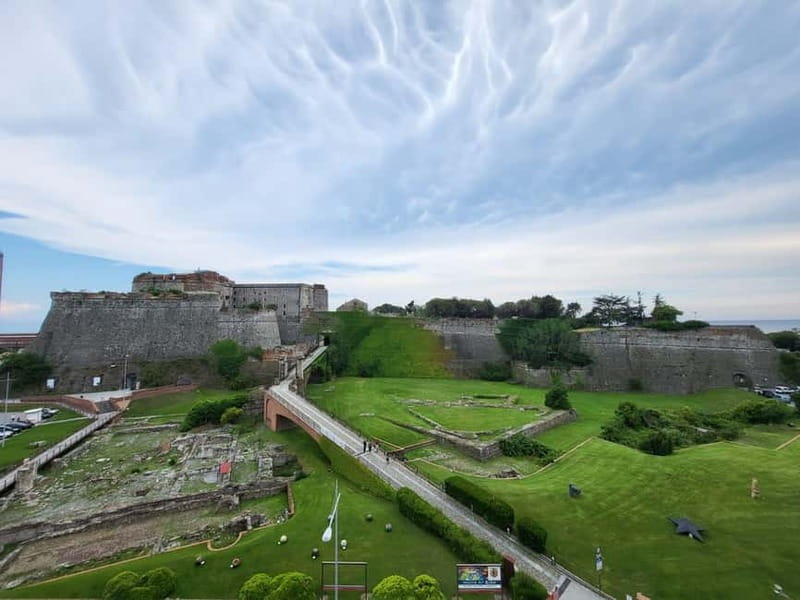
The most surprising part of Priamàr Fortress is what had to disappear to build it. Genoa’s military engineers cleared away a medieval neighborhood, cathedral, bishop’s palace, convent, hospitals, and ten confraternity oratories to create this massive stronghold above Savona. You are not just walking through old walls. You are walking over a buried city.
I like two things right away: the archaeological starting point gives the tour a human story before the military one, and the one-hour length fits neatly into a day of exploring Savona. Guides including Elena, Giorgio, and Diego have been praised for being warm, funny, and ready for questions. The main drawback is practical: the fortress route is not suitable for wheelchair users or people with mobility impairments, even though an elevator reaches the museum entrance.
Key points
- A fortress built to control Savona: Genoa constructed Priamàr in 1542 to guard the coast and keep its recently conquered city under control.
- A medieval city lies beneath the ramparts: The fort replaced Savona’s cathedral district, convent, hospitals, and other major buildings.
- The tour begins in the Civic Archaeological and City Museum: This gives useful context before you walk through the monumental complex.
- Underground areas may be part of the experience: One tour group changed to an underground route during hot weather and found the rooms and passageways especially interesting.
- Guides make the short visit personal: Elena used quiz questions, Giorgio was singled out for his excellent guiding, and Diego shared his enthusiasm for archaeology.
- The price is reasonable for focused history: At $17, you get a live one-hour guided visit in English, German, French, Italian, or Spanish.
Why Priamàr Explains Savona Better Than a Quick City Walk
Savona can be easy to underestimate. Cruise passengers often see it as a port stop, perhaps pausing for a coffee before moving on. Priamàr gives you the larger story in one concentrated visit.
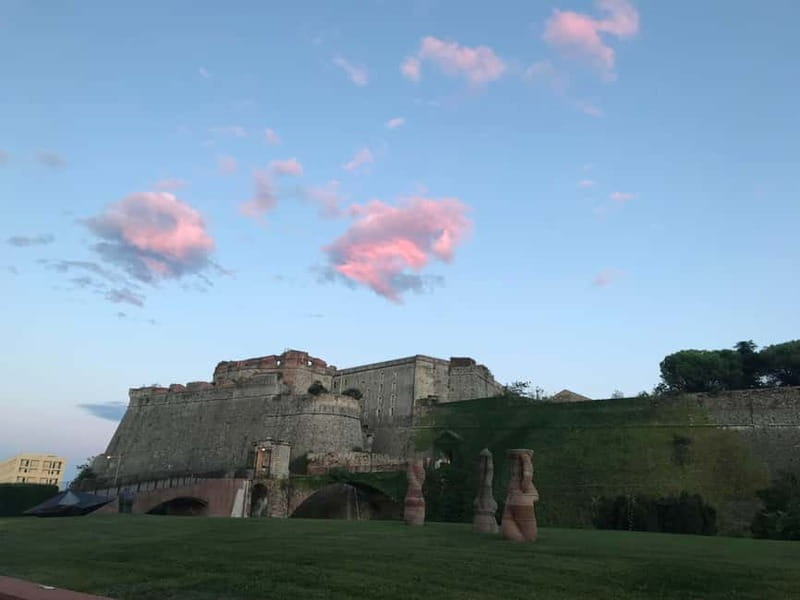
The fortress sits on the rocky Priamàr promontory, the site of Savona’s earliest inhabited area. Its position made sense to military planners. From high ground near the sea, Genoa could defend the coast and watch the city below.
But defense was only part of the plan. Savona had recently been brought under Genoese control, and Priamàr was also meant to keep the city obedient. That makes the fortress more interesting than a simple collection of bastions. Its walls show political power in stone.
I like this setting because the fortifications and archaeology explain each other. You see the structure Genoa built, then learn what it replaced. The result is a compact lesson in warfare, urban planning, and local resistance.
More Fortress and Citadel Tours in Italy
- Fortress: Prisons, Museum of Fortifications and Alps Museum
★ 4.5 · 125 reviews - San Leo: Fortress Entry Ticket and Cagliostro’s Prison
★ 4.2 · 38 reviews - Bard: Fortress Exhibitions and Museums Entrance
★ 4.3 · 29 reviews
Beginning at the Civic Archaeological and City Museum
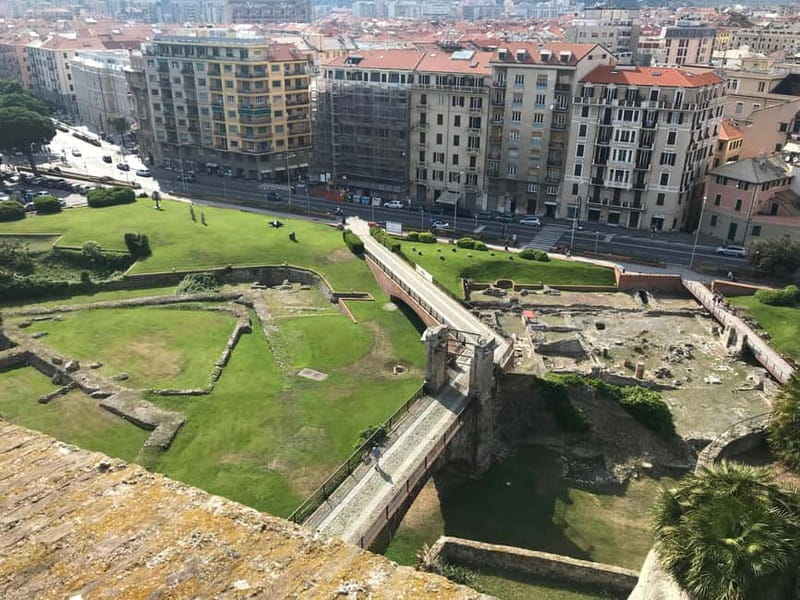
Your meeting point is the Civic Archaeological and City Museum of Savona, located inside the fortress. Enter through the portico at Piazza del Maschio. You can also reach the museum by elevator from the foot of the fortress, using the flat walkway near the car park.
Starting here is a smart choice. Instead of meeting outside and immediately hearing a list of dates, you begin with the city’s physical remains and archaeological story. The museum helps connect Priamàr to the settlement that stood here before the fortification.
The International Institute of Ligurian Studies has carried out systematic excavations since 1956. Work continues to reveal parts of the earlier settlement, and the museum is regularly updated as archaeological understanding develops.
You should not expect a huge museum visit before the tour. The guided experience lasts one hour, so the museum functions as the starting point for the route rather than a separate, long museum program. If you want to inspect every display carefully, plan extra time before or after the guided visit.
The Medieval Neighborhood Sacrificed for Genoa’s Fortress
The hardest fact to picture is the scale of the demolition. To make room for the new walls, Genoa destroyed one of the most important districts of late medieval Savona.
That area included the Cathedral of Santa Maria di Castello, the Bishop’s Palace, the Dominican Convent, ten oratories belonging to confraternities, three city hospitals, and the district that shared the Priamàr name. These were not minor structures at the edge of town. They were central parts of civic and religious life.
This is where a guide adds real value. Without explanation, a fortress can look like stone, stairs, and big views. With the city beneath it in mind, the same walls become evidence of a forced change in Savona’s identity.
I find this the strongest reason to book a guided visit instead of simply wandering around the fort. The route helps you read empty spaces as well as surviving walls. What is missing becomes part of the story.
How the 1542 Construction Changed Savona
The Republic of Genoa began building Priamàr in 1542, following plans by Lombard architect Giovanni Maria Olgiati. The work moved with remarkable speed. After only nine months, the military structure was operational enough to receive its first garrison in April 1543, even though construction was still under way.
That speed tells you something about the political climate. Genoa was not patiently beautifying a hilltop. It was building a working military installation to meet a threat from the sea and from the Savoy state.
The fort also served a quieter but equally important purpose: surveillance and control of Savona itself. The city’s history is therefore present in the fortress twice. You get the practical story of coastal defense and the uncomfortable story of occupation.
I would pay close attention when the guide explains how the rocky promontory shaped the fort. Priamàr was valuable before the walls were built. Genoa used the natural position, then strengthened it with ramparts and military architecture.
More Guided Castle Tours in Italy
- Milan: The Last Supper & Sforza Castle Guided Tour
★ 4.6 · 610 reviews - Milan: Last Supper and Sforza Castle Guided Tour
★ 4.6 · 498 reviews - Valpolicella: Amarone Chateau Guided Tour and Wine Tasting
★ 4.5 · 164 reviews - Milan: The Last Supper & Sforza Castle Guided Tour
★ 4.5 · 128 reviews
Walking Through the Most Impressive Fortification in Liguria
The tour follows an itinerary through the Priamàr complex and returns to the museum. The supplied timing is one hour, so expect a focused route rather than a slow, all-day examination of every corner.
The attraction here is the combination of fortification and excavation. One moment you are considering the defensive structure created by Genoa. The next, you are looking at evidence of the earlier city that the fortress displaced.
That contrast keeps the visit moving. It also makes Priamàr more rewarding than a fortress that only tells its own military story. You are seeing several layers of Savona in one place: the first settlement, the late medieval city, the Genoese stronghold, and the modern archaeological effort to recover what was lost.
The complex is described as the most impressive fortified structure in Liguria. That is a broad claim, but the scale of the project helps explain it. The fort was designed to dominate a strategic promontory and reshape the city below, not merely to protect a small local outpost.
Underground Rooms Can Be a Major Bonus
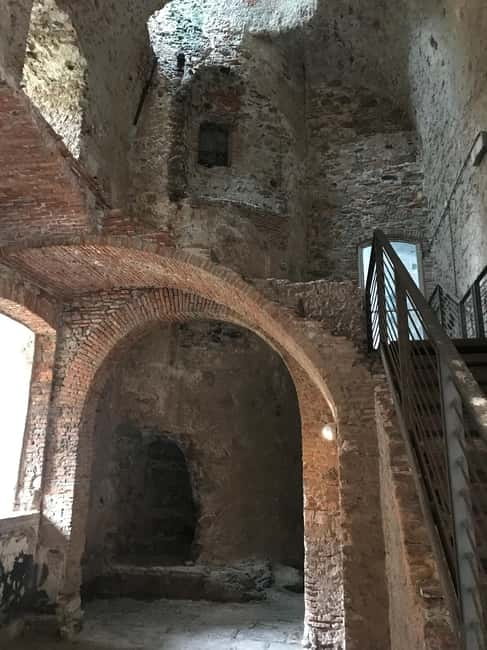
An especially useful detail concerns the underground version of the visit. One group changed to an underground route during intense summer heat and found the rooms and passageways both cooler and fascinating.
You should treat this as a possible variation, not a guaranteed feature of every departure. Ask your guide what route is planned when you arrive, especially if you are visiting in August or dislike exposed sun.
The underground spaces add a different mood to the visit. Above ground, you can understand the fort’s scale and position. Below ground, rooms and passageways suggest the practical, enclosed life of a working military complex.
This option may also make the tour more comfortable in hot weather. Still, underground areas can involve uneven surfaces, steps, or confined passages. The activity is specifically not suitable for people with mobility impairments or wheelchair users, so do not assume that reaching the museum by elevator makes the entire tour accessible.
The Guides Shape This Short Experience
A one-hour visit needs a guide who can choose the right details. The strongest guiding accounts point to a friendly, flexible style.
Elena has been described as kind and funny, answering questions and using quiz questions about the fortress. That approach suits Priamàr well. The site contains many dates and names, but a few questions can help you notice how the fortress worked rather than simply memorize when it was built.
Giorgio received especially strong praise for his guiding. Diego brought archaeology and the history of the fort to life with clear passion. These names matter because the guide is not an extra detail here. The guide is the link between the stones, the destroyed medieval district, and modern excavations.
Tours are offered in English, German, French, Italian, and Spanish. Some content may appear in its original language, so if you need a particular language, check the departure details before booking.
The groups can be small. One booking had only two participants, which allowed the guide to give close attention and move at a comfortable pace. That is not a promise that every tour will be private or tiny, but it suggests the experience can feel personal when attendance is light.
Is $17 Fair for One Hour?
At $17 per person, this is a good value if you want a guided introduction to Savona rather than a long museum session. Your ticket covers the guided visit to Priamàr Fortress, and the route begins inside the Civic Archaeological and City Museum.
The price makes most sense for three types of visitors. First, you get historical context that is difficult to reconstruct on your own. Second, you can ask questions in real time. Third, a guide can point out the relationship between the visible fortress and the buried medieval city.
The value is less clear if you prefer to explore at your own speed or want a full afternoon of museum viewing. One hour passes quickly, and the tour cannot cover every archaeological detail.
I would pair the visit with independent time in Savona. The guided route gives you the framework. Afterward, you can return to areas that caught your attention or continue into the city with a better sense of what Genoa’s fortress changed.
Timing, Access, and Small Practical Details
The advertised duration is one hour, with starting times dependent on availability. That makes it easy to fit around a port call or a short visit to Savona, but you should allow enough time to find the museum entrance inside the fortress.
Look for Piazza del Maschio and the entrance under the portico. If you are arriving by car, the flat walkway and elevators at the foot of the fortress offer the stated route to the museum on the first floor.
The elevator information needs a careful reading. It helps you reach the meeting point, but the full guided visit is not suitable for wheelchair users or people with mobility impairments. If you have a recent injury or difficulty with stairs and uneven ground, contact the provider before reserving. One guide adjusted the pace for a participant with a twisted ankle, but that kind of accommodation should not be assumed for every departure.
The tour is offered with free cancellation up to 24 hours in advance, and you can reserve now and pay later. Those terms help if your Savona plans depend on changing port or transport schedules.
Who Should Book Priamàr Fortress?
I would recommend this visit to anyone who wants Savona’s history to feel connected rather than scattered. It suits history fans, archaeology enthusiasts, architecture students, and curious first-time visitors who want a clear introduction to the city.
It is also a strong choice for a hot day if an underground route is available. The combination of cooler passageways and a live guide can be more comfortable than an exposed walk around the walls.
Families may appreciate the quiz-style approach used by Elena, especially if children lose interest in dates. The one-hour format is manageable, though the mobility limits and possible uneven surfaces deserve attention.
I would think twice if you have very limited mobility, use a wheelchair, or need a fully step-free route. I would also skip it if you only want wide-open views and do not care about archaeology, since the tour’s real strength is the history beneath the fortifications.
Should You Book This Savona Tour?
Book it if you want to understand why Priamàr matters, not just photograph a fortress. For $17, you get a short, focused visit with a multilingual guide, archaeological context, and access to one of Liguria’s major military complexes.
The best reason to go is the story of what lies below and what was destroyed to build the walls. Ask about the underground route, arrive at the museum in Piazza del Maschio, and keep an eye out for a guide such as Elena, Giorgio, or Diego.
Skip it if accessibility is a serious concern or if you need a long, self-paced museum visit. For most able-bodied visitors with an hour to spare, Priamàr offers a compact and worthwhile way to see Savona as a city shaped by power, archaeology, and the sea.
FAQ
Where does the guided visit begin?
It begins at the Civic Archaeological and City Museum of Savona inside Priamàr Fortress. The entrance is in Piazza del Maschio, under the portico.
How long does the tour last?
The guided visit lasts one hour and returns to the Civic Archaeological and City Museum.
What is included in the ticket?
The ticket includes the guided visit to Priamàr Fortress.
How much does the experience cost?
The listed price is $17 per person.
Which languages are available?
The tour is offered in English, German, French, Italian, and Spanish. Some content may be shown in its original language.
Is the tour suitable for wheelchair users?
No. The activity is not suitable for wheelchair users or people with mobility impairments.
Can I reach the museum by elevator?
Yes. Elevators at the foot of the fortress reach the first floor, and the access route is a flat walkway near the car park.
Is an underground route included?
An underground route may be used as a variation of the visit. Ask about the planned route when you arrive, since it is not stated as a guaranteed part of every tour.
Can I cancel for a full refund?
Yes. You can cancel up to 24 hours in advance for a full refund.
Can I reserve now and pay later?
Yes. The booking option allows you to reserve your place and pay later.
Newly walked in Italy
- HIKING TOUR: VARENNA, Castle of VEZIO Villa MONASTERO, FIUMELATTE★ 5.0 · 48 reviews
- Castles of Puglia Day Trip from Bari★ 4.5 · 7 reviews
- Enchanted Castle of Sciacca – Museum Tickets★ 3.5 · 63 reviews
- Taormina; Taormina Castle Tour★ 3.8 · 11 reviews
- St. Angel’s Castle: 2-Hour Private Tour★ 5.0 · 9 reviews
- Milan: Skip-the-line Sforza Castle and Museums Private Tour★ 4.7 · 7 reviews
- Siena: Tour and Wine Tasting in a Tuscan Private Castle★ 4.9 · 50 reviews
- Sforza Castle & Michelangelo’s Pietà Rondanini Guided Tour★ 4.7 · 3 reviews
Fortress & Citadel Tours, compared.



From Cairo Alexandria Catacombs, Citadel Day Trip with Lunch
Read our review →
Charleston historical walking tour with a Professor of History at The Citadel
Read our review →
Hue Customizable Tour with Imperial Citadel & Forbidden City
Read our review →
Desert Safari: Luxury Fortress Dinner, Camel Ride & Dune Bashing
Read our review →
Egyptian Museum, Citadel, and Old Cairo Guided Tour
Read our review →Browse the lists this tour appears in