
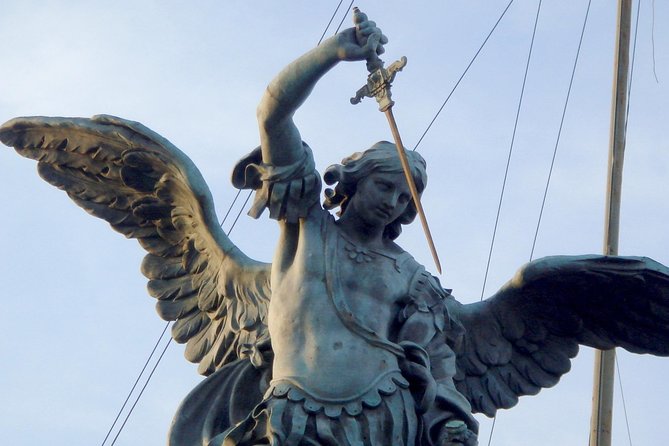
Review · ROME
Private Tour – St. Angel’s Castle
Castel Sant’Angelo is not just another old Roman monument. It began as Emperor Hadrian’s grand mausoleum, then became a fortress, prison, Vatican stronghold, and museum. A private tour gives you time to connect those changing roles instead of simply climbing through a stone maze and reading labels.
I like two things here: a private guide can answer your questions, and the tour includes the admission ticket, so you avoid dealing with the ticket line at the entrance. I also like the choice of morning or afternoon departures, which helps you fit the castle around the Vatican, Pantheon, or an evening meal.
The main drawback is price. At $138.17 per person, this is a serious spend for about two hours, especially if you are traveling alone or with a large family. You are paying for private attention and storytelling, not just entry to the monument.
Key points to know before booking
- Hadrian’s mausoleum became a fortress: The building’s long transformation gives the tour a clear story, from imperial tomb to Vatican defense post.
- The terrace is the payoff: You get broad views across Rome’s historic center after exploring the interior.
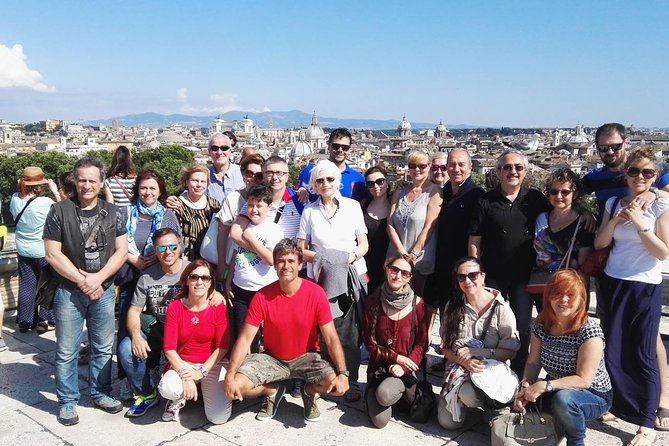
- Vincent brings the history to life: He is praised for lively storytelling, strong English, and an easy way with questions.
- The experience is private: Only your group takes part, so the guide can adjust the pace and focus.
- Tickets are included: You do not need to buy admission at the castle entrance.
- Plan for moderate walking and stairs: The activity lasts around 2 hours and 15 minutes, with the castle’s interior and upper viewpoints to cover.
Why Castel Sant’Angelo deserves your time
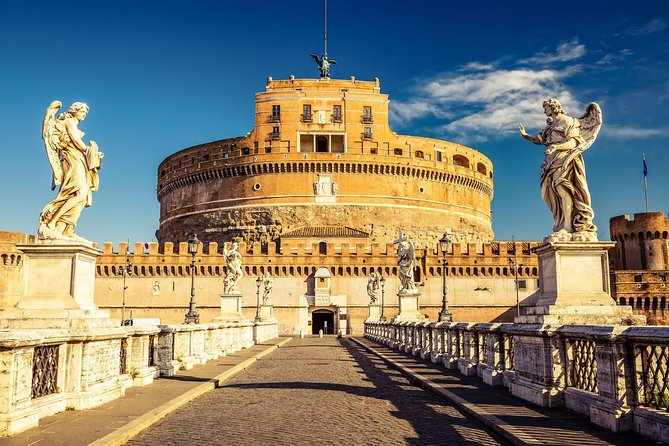
Castel Sant’Angelo sits beside the Tiber near the Vatican, linked to the city by the Aelius Bridge. Its shape is hard to miss: a broad cylindrical core topped by later defensive additions. The building looks like a fortress because it became one, but that was not its first purpose.
Hadrian built the original structure between 117 and 138 AD as a mausoleum for himself and later emperors. That fact gives the visit an unusual starting point. You are not entering a palace designed for daily court life or a temple built for worship. You are entering a monumental tomb that was later forced into new jobs by Rome’s changing political needs.
Over the centuries, Castel Sant’Angelo became part of the defensive system protecting Vatican City. It held a military garrison, served as a prison, and housed offices connected to the Vatican Treasury and Archive. The building’s past is therefore practical as well as grand. It tells you how Rome repeatedly reused old structures instead of letting them become obsolete.
I find that kind of layered history especially useful on a private tour. A guide can explain why one corridor feels defensive, why another room is decorated like a palace, and how the same building could serve both religious and military purposes. Without that context, you may see handsome rooms and thick walls but miss the reason they are together.
More Private Castle Tours in Italy
- Milan Private Tour – Duomo, Sforza Castle & Gelato Tasting
★ 5.0 · 40 reviews - Milan: Duomo, Scala, Sforza Castle and Last Supper Private Tour
★ 5.0 · 38 reviews - Milan: Private Tour – Duomo, Sforza Castle & Gelato Tasting
★ 4.8 · 36 reviews
From imperial tomb to Vatican fortress
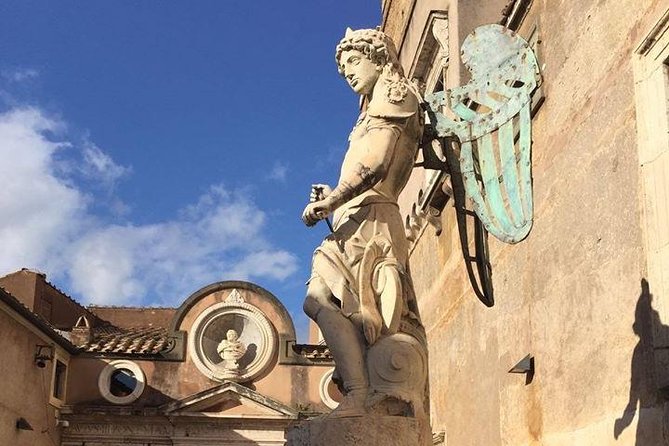
The first part of the visit focuses on the building’s identity as Hadrian’s mausoleum. The original purpose matters because it explains the castle’s unusual circular form and scale. You can picture an emperor creating a monumental final resting place, then later generations altering it for defense and administration.
The Aelius Bridge in front of the mausoleum was built at the same time. Its position helped connect the tomb with the city and still makes the approach memorable. The bridge and castle form a strong visual pair, especially as you arrive along the Tiber.
The castle’s later use as a Vatican defense post adds another layer. Its location gave it strategic value near the Vatican, and its walls could protect people and records during periods of danger. The tour’s strength is that it connects the rooms to those functions rather than treating the building as a collection of disconnected sights.
You will also hear legends and stories tied to the fortress. The experience is offered in English, and the guide is expected to explain the material in a conversational way. Vincent is the guide specifically praised in the supplied comments, with attention called to his passion, clear English, and ability to make the subject fun. Guide assignments can change, so confirm the name if that matters to you.
The frescoed rooms inside the castle
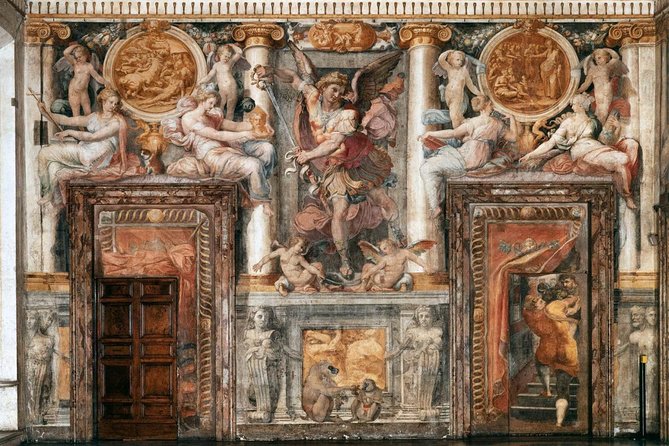
The interior includes several richly decorated halls from the seventeenth century. These rooms change the mood of the visit. Outside, the castle suggests military power. Inside, painted walls and formal decoration reveal the building’s later role in papal administration and ceremony.
The Hall of Apollo is one of the named rooms on the route. The Hall of Paolina is decorated with scenes from the life of Alexander the Great, while the Hall of Perseus presents episodes from the Greek hero’s myth. The Room of Amore and Psiche adds another mythological theme.
These rooms are important because they show that Castel Sant’Angelo was not only a bunker or prison. Powerful occupants also wanted refined spaces for work, display, and official life. The contrast between thick defensive architecture and elaborate decoration is one of the most interesting features of the visit.
A private guide helps most in these rooms. Mythological scenes can blur together when you are moving quickly through several palaces and churches in Rome. A good explanation can point out the subject, explain why it was chosen, and show how the room fits the building’s later history.
The tour is not described as a specialist art lecture, so you should not book it expecting a long technical study of every painter or fresco. Instead, you get a broad look at the art, architecture, and changing uses of the castle. That balance suits most first-time visitors who want context without spending half a day on one building.
Prisons, weapons, and working history
Castel Sant’Angelo also contains prisons and a collection of antique arms. These sections bring the fortress’s harder side into view. The decorated halls may suggest comfort and ceremony, but the prison areas remind you that the building was also a place of confinement.
The arms collection supports the castle’s defensive role. It helps you see the monument as a functioning military site rather than a dramatic shell. The exact display can matter less than the connection between the walls, the garrison, and the need to control access to the Vatican area.
I like this mix because the visit does not depend on one type of interest. You can care about Roman history, Renaissance decoration, military architecture, or old weapons and still find something to hold your attention. The private format also means you can ask for more detail in the section that interests you most.
The physical side deserves a little thought. The tour lasts about two hours and fifteen minutes, and the castle’s rooms, prison areas, collections, and terrace require walking through a large historic building. The stated requirement is moderate physical fitness. If you dislike stairs or extended walking, ask about the route before booking rather than assuming the private format changes the monument’s layout.
Same walls, a different way in:
- Milan: Sforza Castle Entry Ticket with Digital Audio Guide
★ 4.0 · 2,675 reviews - Milan: Sforza Castle and Michelangelo’s Pietà Rondanini Tour
★ 4.7 · 1,119 reviews - From Siena: Chianti and Castles Tour with Wine Tastings
★ 4.6 · 631 reviews - Milan: The Last Supper & Sforza Castle Guided Tour
★ 4.6 · 610 reviews
Paintings, sculpture, and the castle collections
The castle’s painting gallery includes works by Carlo Crivelli, Luca Signorelli, and Dosso Dossi. You will also find ancient marbles, ceramics, and sculptures. These collections broaden the visit beyond architecture and military history.
The art is another reminder that Castel Sant’Angelo changed with the needs of its owners. A mausoleum became a fortress, but it also became a place where valuable objects, records, and works of art were kept. The building’s collections help connect the castle to Rome’s wider tradition of papal power and patronage.
You should keep expectations measured. This is a two-hour private visit, not a full museum course. The guide will likely use the main works and rooms to explain the monument’s story rather than spend equal time on every object. That is a sensible approach in Rome, where a day can otherwise disappear into labels and galleries.
If you have a particular interest in Crivelli, Signorelli, or Dossi, mention it when booking or at the start. The private format makes that sort of request more realistic than it would be in a large group, though the supplied details do not promise a specialized art itinerary.
The terrace and the Rome view
The terrace is one of the strongest reasons to visit. From above, you get one of the best panoramic views of Rome’s historic center. After moving through tomb chambers, fortress spaces, frescoed halls, and prison areas, the open view gives the visit a satisfying finish.
The view also explains the castle’s location. From this height, you can better understand the relationship between the Tiber, the bridge, the Vatican area, and the dense historic center. A guide can help identify what you are seeing, turning a pleasant panorama into a useful orientation point for the rest of your day.
I would not rush the terrace. The tour is scheduled for roughly two hours, but the exact pace depends on your group and guide. If photographs matter to you, leave a little mental space for the viewpoint rather than treating it as a quick stop before the end.
The experience begins and ends at Castel Sant’Angelo, at Lungotevere Castello 50. There is no hotel pickup, drop-off, or private transport. You need to make your own way to the meeting point, which is near public transportation. That arrangement keeps the tour focused on the monument, but you should allow enough time to arrive without hurrying.
Is the private format worth $138.17?
The price is $138.17 per person, with group discounts available. That is not the budget choice for Castel Sant’Angelo. If you mainly want to enter, wander, and take the terrace photos, a private guide may cost more than you need.
The value improves if you want a clear story and the freedom to ask questions. This castle has many identities, and its rooms do not automatically explain how a mausoleum became a Vatican defense post, prison, archive, and museum. A strong guide saves you from piecing that together alone.
The private format is also useful for a group with different interests. One person can ask about Hadrian, another about the frescoes, and another about weapons or prison life. In a large group, those questions may be limited by time. Here, the guide can respond directly and adjust the emphasis.
The supplied feedback gives Vincent particular credit for storytelling, interaction, and English. Those are exactly the qualities that can make the difference in a short private visit. Still, no tour can guarantee a particular guide unless the operator confirms it, and the price should be judged on the full experience rather than one named guide.
For a couple or small group that values personal attention, the cost may make sense. For a family watching every euro, or a solo visitor who is comfortable reading and exploring independently, it is harder to justify. The group discount may help, but the exact savings are not specified.
Choosing morning or afternoon
You can choose a morning or afternoon tour. That flexibility is useful in Rome, where your schedule often depends on timed entries and meal breaks.
A morning visit can work well if you want to see the castle before a later Vatican or central Rome plan. An afternoon time may suit you if you prefer a slower start or want to place the castle between other sights. The tour provider does not state a special lighting advantage for either time, so choose based on your day rather than expecting a different route.
The activity is offered in English. If your group needs another language, this tour is not presented as a match. Confirmation is provided at booking, and free cancellation is available if you cancel at least 24 hours before the local start time. Changes or cancellations made later are not accepted for a refund.
Who should book this Castel Sant’Angelo tour?
I would choose this experience if you want the building’s story explained in person and prefer a private pace. It is particularly well suited to couples, families, and small groups who enjoy asking questions or who have mixed interests in art, military history, and Rome’s ancient past.
It is also a good fit if the terrace view matters to you but you want more than a quick photo stop. The guide can connect the view to the castle’s role beside the Vatican and the Tiber.
I would skip it if you want the cheapest possible entrance, dislike structured visits, or have only a short time in Rome and cannot spare about two hours. You should also think twice if moderate walking inside a historic fortress would be difficult.
FAQ
Where does the Castel Sant’Angelo tour start?
The tour starts at Castel Sant’Angelo, Lungotevere Castello 50, 00193 Rome, Italy.
Where does the tour end?
The activity ends back at the meeting point at Castel Sant’Angelo.
How long does the private tour last?
The tour lasts approximately 2 hours and 15 minutes.
Is admission to Castel Sant’Angelo included?
Yes. Tickets are included in the tour price.
Is transportation included?
No. Hotel pickup, hotel drop-off, and private transportation are not included.
Is the tour private?
Yes. Only your group participates in the activity.
Is the tour offered in English?
Yes. The tour is offered in English with a local professional guide.
Can I cancel for a refund?
Yes. You can receive a full refund if you cancel at least 24 hours before the experience start time. Cancellations or changes made less than 24 hours before the start are not refunded.
Should you book it?
Book this tour if you want Castel Sant’Angelo explained as a changing Roman institution, not just photographed as a fortress. The combination of Hadrian’s mausoleum, Vatican defenses, frescoed halls, prisons, collections, and terrace views gives the visit plenty of substance.
At $138.17 per person, it is best for people who value private attention and lively storytelling. Vincent’s praised English and engaging style are a strong reason to ask if he will be your guide, but the core value is the private format, included ticket, and focused two-hour visit. If those matter more to you than saving money, this is a sensible way to see one of Rome’s most layered monuments.
Newly walked in Italy
- Postojna Cave & Predjama Castle from Trieste★ 4.5 · 122 reviews
- City walk through Spanish steps, Trevi fountain, Pantheon, Navona, Angel Castle★ 5.0 · 55 reviews
- Milan Private Tour – Duomo, Sforza Castle & Gelato Tasting★ 5.0 · 40 reviews
- Milan: Duomo, Scala, Sforza Castle and Last Supper Private Tour★ 5.0 · 38 reviews
- Milan: Private Tour – Duomo, Sforza Castle & Gelato Tasting★ 4.8 · 36 reviews
- Private 2-Hour Tour of the Medieval Castle over Lake Como★ 5.0 · 9 reviews
- Palermo: Medieval castles of Caccamo & Cefalù. Small Group Tour★ 5.0 · 24 reviews
- Private daytour medieval castles from Civitavecchia port★ 4.5 · 7 reviews
Private Castle Tours, compared.

Cairo Citadel, Old Cairo and Khan El Khalili: Private Tour
Read our review →
From Amman: Jerash, Ajloun Castle or Umm Qais Private Tour
Read our review →
Seville Private Walking Tour with Alcazar & Cathedral Tickets
Read our review →
Sintra Cascais Private Tour with Pena Palace and Mouros Castle
Read our review →
Skip-the-Line Wawel Castle Chambers Private Tour
Read our review →
Castles of Transylvania: Private Day Trip from Bucharest
Read our review →
Dracula’s Castle, Peles Castle and Brasov – Private Day Trip from Bucharest
Read our review →
Neuschwanstein & Linderhof Castle Luxury Private Tour from Munich
Read our review →Browse the lists this tour appears in