
Review · JAPAN
Tokyo Castle & Imperial PalaceーShogun Walking Tour
Tokyo’s Imperial Palace grounds make more sense once you understand that this was not simply a royal residence. It was the center of Edo Castle, a vast military stronghold built to protect the shogun. This two-hour English walking tour turns gates, stone walls, and empty foundations into a story about samurai power, palace security, and Japan’s long imperial system.
I like the focused route and the guides’ use of old plans and laminated images to show what the castle once looked like. I also like the price, $23.88 per person, which is fair for a small-group history walk. The main drawback is that much of the route is outdoors, with steep slopes and stairs, and the Emperor’s residence itself is not open to the public.
Key points to know before you book
- See the castle’s defensive design up close: Massive gates, layered walls, guardhouses, and watchtowers explain how Edo Castle protected the shogun.
- Get context you would miss alone: Guides connect the buildings to samurai rank, daily security, the shogunate, and Japan’s 2,600-year imperial system.
- Enjoy a calm garden finish: Ninomaru Garden adds ponds, koi, seasonal plants, and a welcome change of pace after the fortress stops.
- Expect an English-only tour: Japanese language support is not available, so this works best if you can comfortably follow spoken English.
- Plan for sun and walking: Much of the route is exposed, and you will need to handle stairs and steep slopes.
- Check the group size at booking: The tour is described as a small group of up to 10, while the general activity limit is listed as 60 people.
Why Edo Castle is the real subject
The name Imperial Palace can make this sound like a formal palace visit. It is not. You will not enter the Emperor’s residence, and you will not tour lavish indoor rooms.
Instead, you walk through the former grounds of Edo Castle. That distinction matters. The castle was the political and military heart of Japan during the shogun era, while the Imperial Palace today carries the country’s modern imperial role. The tour uses the surviving walls, gates, guardhouses, gardens, and foundations to connect those two periods.
That makes this a useful first or second-day activity in Tokyo. If the names shogun, samurai, Edo, and emperor tend to blur together, a guide can give you a basic framework. The best guides, including K, Keiko, Ai, Tomo, Shin, and others praised for their clear explanations, add stories and visual aids rather than simply pointing at stones.
The tour is conducted in English only. Several guides are described as warm, funny, and easy to understand, but one unhappy participant found the guide’s English difficult and left early. I would treat that as a reminder to book this only if you are comfortable listening to spoken English for two hours.
More Castle Walking Tours in Japan
- Tokyo Castle & Imperial PalaceーShogun Walking Tour
★ 4.7 · 1,068 reviews - Ultimate Osaka Walking Tour: Castle, Dotonbori & Hidden Gems
★ 5.0 · 862 reviews - Osaka Castle Walking Tour and Castle Tower Admission
★ 5.0 · 561 reviews
Starting at Wadakura Fountain Park
The meeting point is the Starbucks Coffee at Kokyo Gaien Wadakura Fountain Park, 3-1 Kōkyogaien, Chiyoda City. The area is near public transportation and puts you close to the Imperial Palace’s outer grounds.
Arrive ready to walk. You will need to pass through a security check before entering the Imperial Palace grounds, so leave knives and alcohol behind. A mobile ticket is provided, and booking confirmation is received at the time of booking.
The advertised format is a small group of up to 10 people, which is a strong reason to choose a guided walk over a large bus-style excursion. A small group lets you hear explanations more easily and ask questions about samurai rank, the castle layout, or the imperial family. The activity information also gives a maximum of 60 participants, so check the specific departure when booking if group size is important to you.
Sakurada Tatsumi Yagura and the first look at castle defenses

The first stop is Sakurada Tatsumi Yagura, a surviving turret from the Edo period. You spend about 20 minutes here, making it the longest stop on the route.
A turret is more than a picturesque old structure. It was part of the castle’s watch and defense system, giving guards a position from which to monitor movement around the grounds. Your guide explains how security arrangements still shape access to the Imperial Palace today.
This is a good opening stop because it introduces the tour’s main idea: Edo Castle was designed as a system. The walls, gates, guard posts, and inner sections worked together. You are not looking at isolated ruins. You are learning how a powerful ruler made it difficult for enemies to reach him.
Otemon Gate and the logic of an impenetrable castle
At Kokyo Otemon Gate, you see two large gates and thick stone walls connected with the former castle. The stop lasts about 10 minutes, but it carries a lot of the tour’s military story.
Your guide explains how the arrangement slowed attackers and controlled movement. The repeated gates are easy to admire as architecture, but their real purpose was practical. A visitor could not simply walk straight into the castle’s center.
This is where the title’s promise about Edo Castle’s defenses becomes useful. The castle was never breached, and the tour explains why its design made a direct attack so difficult. You do not need a technical background to follow the point. The walls and narrow approaches make the strategy visible.
Same walls, a different way in:
- Osaka Castle: Museum and Tower Entry Ticket
★ 4.5 · 2,380 reviews - Kyoto: Nijo-jo Castle and Ninomaru Palace Guided Tour
★ 4.7 · 1,020 reviews - Kyoto: Nijo Castle, Kiyomizu & Fushimi Inari Guided Tour
★ 4.7 · 700 reviews - Imperial Palace East Garden and Edo Castle Walking Tour in Tokyo
★ 5.0 · 510 reviews
Three guardhouses and the samurai social order
The Constable Guardhouse, Hyakunin Bansho Guardhouse, and Obansho Guardhouse form the historical core of the walk. Each stop takes about 10 minutes, and each one deals with a different level of castle security and samurai duty.
The Constable Guardhouse was used by lower-ranking samurai. That detail helps correct the common image of the samurai as one uniform class. Rank mattered, and so did assignment. Some men guarded important approaches, while others served in less prestigious posts.
Hyakunin Bansho was a larger guardhouse where many samurai were stationed. Your guide explains their role in watching the route toward the inner castle. The scale of the post helps you picture the number of people needed to protect a ruler and manage a huge compound.
Obansho stood near an inner gate and was associated with higher-ranking samurai. Here, the tour shifts from numbers to status and responsibility. You learn that the castle was also a carefully ordered workplace, with rank reflected in where people served and what they were expected to do.
This sequence is one of the tour’s best features. Instead of hearing a general lecture about samurai, you see where different groups worked. Guides such as Keiko have used historical images and old castle layouts to make that system easier to picture.
Fujimi-yagura and the view from an old watchtower
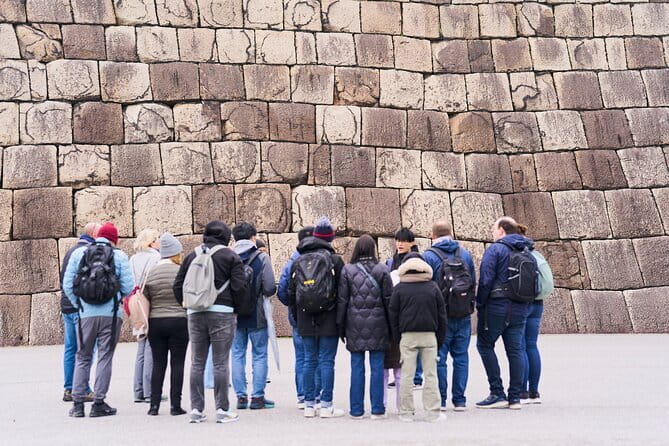
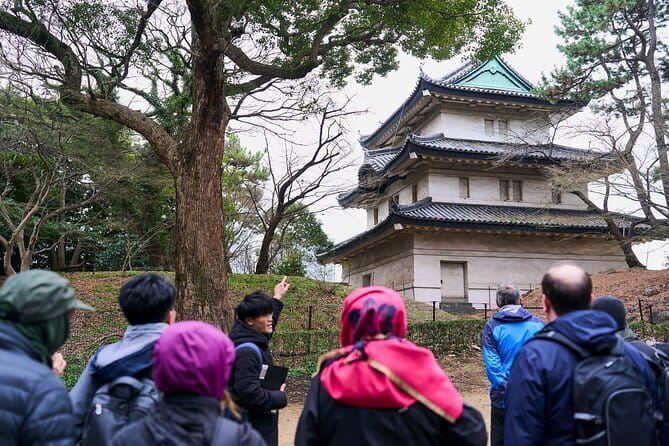
Fujimi-yagura is an old watchtower overlooking the surrounding area. The stop lasts about 10 minutes and adds another piece to the castle’s defense plan.
The tower’s importance comes from its position and purpose. A watchtower gave guards a higher point from which to observe the grounds. Your guide explains what made this structure useful in the past and how it fitted into the larger castle layout.
Do not expect a dramatic tower interior or a long climb. The value is in seeing the structure in place and understanding how the castle used height, walls, gates, and controlled routes together. This is also a good photo stop, especially if you want an image that feels more connected to the old castle than a modern city view.
A model of the lost castle at Kokyo Sannomaru Shozokan

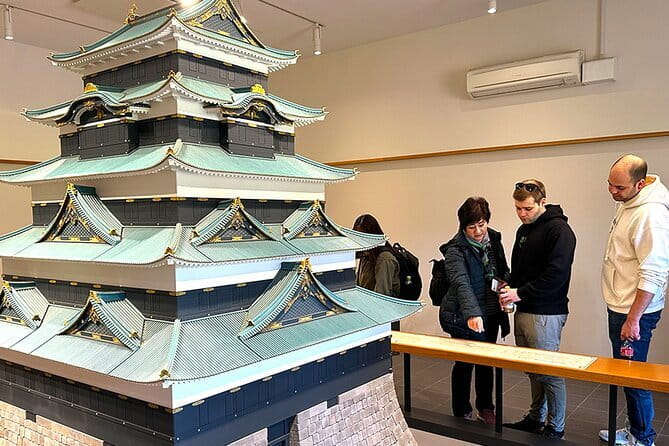
At Kokyo Sannomaru Shozokan, you can see a scale model of the former Edo Castle and visit a souvenir shop with palace-related goods. The stop is listed at about 10 minutes.
The model is especially useful because little of the main castle tower remains. A map or model can show the size and arrangement of the original compound far better than a lone foundation. It helps you understand how the separate gates and guardhouses fit into one large fortified center.
This is also a natural pause in the walking route. If you want a palace-themed souvenir, this is the place to browse. The stop is brief, so do not expect a long museum visit. Think of it as a visual aid and short shopping opportunity rather than a full indoor attraction.
The Edo Castle tower ruins
The East Gardens of the Imperial Palace include the former site of Edo Castle’s main tower. You spend about 15 minutes here learning why the tower no longer stands and what remains.
For many people, this is the moment when the scale of the castle becomes clearest. A modern garden now covers much of the area, but the former tower site points to the power once concentrated here. The absence of the tower is part of the story, not a failure of the visit.
Your guide fills in the gap between the visible ground and the lost structure. This is where a guided tour earns its fee. Without context, you might see a lawn, stones, and a rise in the ground. With context, you can picture the castle’s former central landmark and understand why it disappeared.
Ninomaru Garden, koi, and a quieter side of the grounds
The final major stop is Ninomaru Garden, where seasonal plants surround a pond with koi. The scheduled time is about 15 minutes.
After the gates, walls, and guardhouses, this peaceful garden gives the tour a welcome change of mood. It shows that the castle grounds were not only about defense and authority. Gardens also provided beauty, order, and a place apart from the hard military edge of the outer fortifications.
The garden is one of the best places to slow down and take photos. It may also be the most pleasant stop on a hot day, although the route overall is still exposed to the sun. Guides have been praised for adding extra time and answering questions, but the tour remains organized around a two-hour schedule, so do not count on an extended garden visit.
Ending near Tokyo Station
The walk concludes along the ginkgo-lined avenue stretching toward Tokyo Station, and the activity ends back at the meeting point. The finish gives you a useful orientation point in central Tokyo.
The return to the starting area also keeps the tour easy to pair with other plans. You are not left at a distant suburb or required to arrange a separate ride back. Since the tour covers several stops in a compact historic area, the ending feels practical rather than theatrical.
What the $23.88 price gets you
At $23.88, this is a modestly priced guided walk. Admission to the listed stops is free, so you are mainly paying for the guide’s explanations, route planning, and help connecting the remains to the wider story of Japan.
That is good value if you want more than attractive gardens. Several guides, including K, Shin, Keiko, Ai, Yuuki, and Mako, are described as passionate, patient, and able to answer questions. One guide even used old layouts, guardhouse images, and pictures of the royal family to make the talk more visual.
You can walk through the East Gardens independently, so the tour is not essential for access. The question is what kind of visit you want. If you prefer to read signs quietly and move at your own pace, save the money. If you want to understand how shogun rule, samurai rank, imperial history, and castle defense fit together, the fee is sensible.
Heat, clothing, and walking effort
Wear comfortable shoes. You will cover several sections on foot and encounter stairs and steep slopes. The route is manageable for most people, but it is not a flat indoor museum circuit.
Bring water, a hat, or an umbrella for sun protection. Much of the route is exposed, and one particularly hot outing was made easier with sweets and menthol wipes supplied by the guide. That kindness may not be standard on every departure, so prepare as if you need to manage the heat yourself.
Rain is possible, too. A guide has continued explaining the grounds in wet weather, but conditions will affect comfort and photos. Check the forecast and dress for two hours outside.
The tour has no stated health restrictions, and most people can participate. Still, anyone with trouble on stairs or steep paths should consider the physical demands before booking.
Who should book this walk?
I would choose this tour for a first visit to Tokyo, especially early in your stay. It gives you a useful base for understanding Edo, the shoguns, samurai service, and the imperial institution before you visit other historic parts of Japan.
It also suits families and mixed-age groups because the walk is short, the stops change often, and the subject has plenty of built-in drama. A guide who uses pictures and stories can keep the castle remains from feeling abstract.
History fans will get the most from it, but you do not need prior knowledge. The tour starts with the physical defenses and builds toward the larger story. You can ask questions as you go, and the best guides are described as patient and clear.
I would skip it if your main goal is to enter the Emperor’s residence, see lavish interiors, or spend a quiet morning alone in the gardens. That experience is not offered here. I would also think twice if you dislike walking in heat or need fully accessible paths.
Should you book the Tokyo Castle and Imperial Palace Shogun Walking Tour?
Book it if you want the Imperial Palace grounds to tell you something. For $23.88, you get a compact route through turrets, gates, samurai guardhouses, castle ruins, and a Japanese garden, with an English-speaking guide supplying the missing context.
The strongest reason to go is the guide. K, Keiko, Ai, Tomo, Shin, Yuuki, and others have brought humor, visual aids, patience, and enthusiasm to the walk. The weakest point is that the experience depends on clear English and good weather.
If that trade-off works for you, this is a practical, well-priced introduction to Tokyo’s shogun and imperial past. Free cancellation is available up to 24 hours before the start time, which gives you some flexibility while planning.
FAQ
How long does the tour last?
The tour lasts approximately two hours.
How much does the tour cost?
The listed price is $23.88 per person.
Is the tour offered in Japanese?
No. The tour is conducted in English only, and Japanese language support is not available.
Where does the tour start?
It starts at Starbucks Coffee in Kokyo Gaien Wadakura Fountain Park, 3-1 Kōkyogaien, Chiyoda City, Tokyo 100-0002, Japan.
Where does the tour finish?
The tour concludes back at the meeting point, after finishing near the ginkgo-lined avenue leading toward Tokyo Station.
Can I enter the Emperor’s residence?
No. The Emperor’s residence is not open to the public as part of this activity.
Are there security restrictions?
Yes. There is a security check to enter the Imperial Palace grounds. Do not bring knives or alcohol.
Is the tour suitable for people with limited mobility?
The tour has no stated health restrictions, but it includes steep slopes and stairs. Most people can participate, but you should consider your ability to walk on those surfaces for about two hours.
Newly walked in Japan
- Himeji: Private Guide Tour of the Castle from Osaka or Kyoto★ 4.5 · 7 reviews
- World Heritage Himeji Castle & Sake Breweries Private Tour★ 4.5 · 11 reviews
- From Nagoya: Samurai Swords and Inuyama Castle Private Tour★ 5.0 · 11 reviews
- 2.5 Hour Private History and Culture Tour in Himeji Castle★ 5.0 · 185 reviews
- Himeji: Himeji Castle Guided Tour – UNESCO Heritage★ 4.7 · 115 reviews
- Kyoto: Nijo Castle World Heritage Guided Tour with Admission★ 5.0 · 128 reviews
- Osaka: Osaka Castle Guided Tour with Local Guide★ 4.7 · 78 reviews
- Osaka: Osaka Castle & Historical Museum Guided Tour★ 4.8 · 28 reviews
Castle Walking Tours, compared.

Edinburgh Castle: Guided Walking Tour with Entry Ticket
Read our review →
3-Hour Walking Tour of Old Town & Prague Castle
Read our review →Edinburgh Castle: Guided Walking Tour with Entry Ticket
Read our review →

Prague 3-hour Afternoon Walking Tour including Prague Castle
Read our review →
Royal Mile and Edinburgh Castle – Small Group Walking Tour
Read our review →

Browse the lists this tour appears in