
Review · JAPAN
Okinawa: Shurijo Castle & Tamaudun Guided Tour – UNESCO Site
Shurijo Castle was built to project royal authority, but not in the usual fortress style. Its curved limestone walls, vermilion halls, sacred sites, and Chinese-inspired details reveal a kingdom that favored diplomacy and trade. I like that this tour pairs the castle with Tamaudun, where Ryukyuan kings and queens were laid to rest, then continues along an old stone road where the royal capital feels more human and lived-in.
I also like the choice of starting at Naha Airport, useful on arrival day, or coming early for the Opening Gate Ceremony at sunrise. The main drawback is important: Shurijo’s Seiden, or Main Hall, was destroyed by fire in 2019 and is still being restored. You are seeing a historic site in recovery, not a fully finished palace.
Key points to know before booking
- Shurijo was a court and sacred center, not a military fortress: Expect palace architecture, ceremony, diplomacy, and religious sites rather than defensive ruins.
- Tamaudun adds a serious second chapter: The royal mausoleum explains Ryukyuan ideas about ancestors, death, and royal continuity.
- Kinjo Stone-Paved Road brings history down to street level: Forested paths, old homes, and stone walls offer a quieter look at daily life.
- The sunrise option includes a rare ceremony: The early version lets you see the castle gates open at sunrise.
- The airport pickup can simplify arrival day: Your guide can meet you at Naha Airport’s monorail station and accompany you to the castle.
- This is a private English-language walk: The three-hour format allows room for questions and conversation, rather than a rushed group stop.
Shurijo Castle shows a different kind of royal power
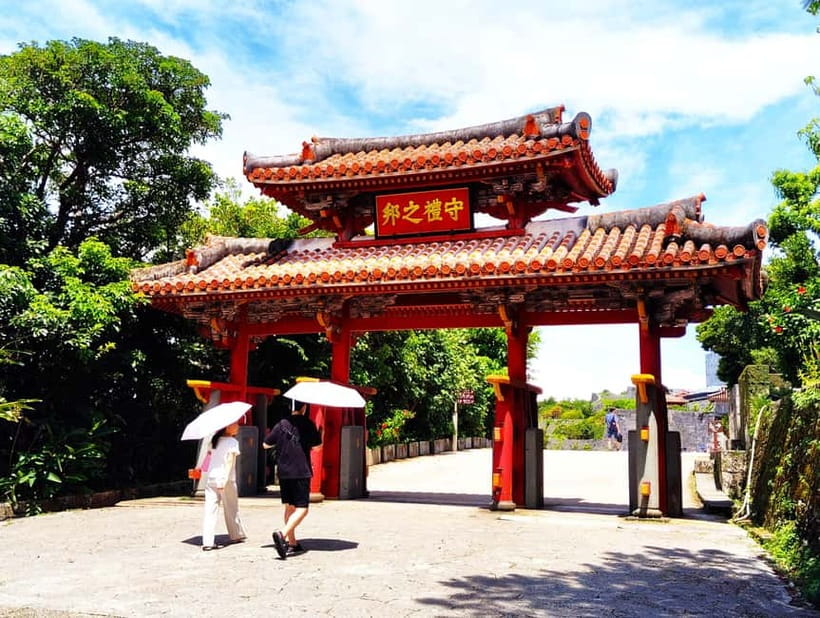
Your visit begins at Shurijo Castle, the former seat of the Ryukyu kings and the spiritual center of the old kingdom. From the 15th century, it served as the court of King Sho Hashi, the ruler credited with uniting Okinawa’s three regional powers.
The key point is that Shurijo was designed less like a fortress and more like a palace for diplomacy. The Ryukyu Kingdom built its influence through overseas connections, trade, and careful relations with nearby powers. That makes the site especially useful if you want to understand Okinawa as something more than a tropical Japanese island.
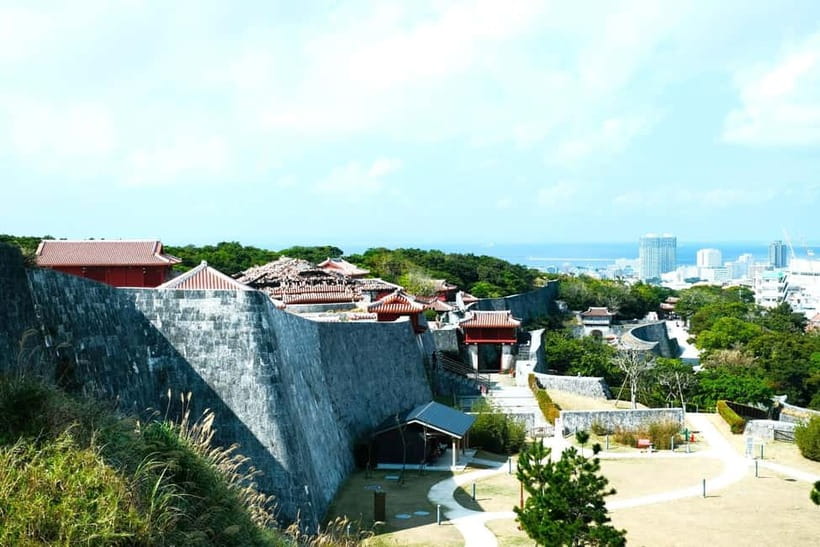
Your guide can help you read the architecture. The vermilion buildings reflect strong Chinese influence, while the sweeping limestone walls and sacred areas belong to Okinawa’s own traditions. The combination is distinctly Ryukyuan. You are not simply looking at an old Japanese castle with a different coat of paint.
The castle grounds also contain multiple utaki, or sacred sites. These spaces matter because royal authority and spiritual authority were closely linked. A ruler’s role was not only political. The court also connected itself to ancestors, island spirits, and sacred places.
At the highest point behind the Seiden, you can look toward Kudaka Island. In Ryukyuan belief, Kudaka is tied to the spiritual beginning of life. That view gives the castle more meaning than a standard palace overlook. Your guide can explain how the court’s power was linked to the sacred geography of the islands.
More Guided Castle Tours in Japan
- Kyoto: Nijo-jo Castle and Ninomaru Palace Guided Tour
★ 4.7 · 1,020 reviews - Kyoto: Nijo Castle, Kiyomizu & Fushimi Inari Guided Tour
★ 4.7 · 700 reviews - Kyoto: Imperial Palace & Nijo Castle Guided Walking Tour
★ 4.7 · 453 reviews
What the 2019 fire means for your visit
You should arrive with realistic expectations. The central Seiden was destroyed by fire in 2019, and restoration is underway using historical documents and traditional craftsmanship.
That means some of the most recognizable palace interiors and features are not available in their complete form. If you have seen photographs of a fully restored main hall, the present visit will feel different. The site is still an active place of repair and remembrance.
I do not see this as a reason to skip Shurijo, but it does change the value of the tour. A guide is especially useful while restoration continues because you can better understand what was lost, what remains, and how the rebuilding process is being approached. Without context, you might spend much of your visit looking at construction activity and wondering what you are missing.
The surviving gates, walls, grounds, sacred sites, and views still give you a clear sense of the old court. The fire also adds a current chapter to the visit. You are seeing a major Okinawan cultural site during a long process of recovery, not visiting a polished replica with every detail already complete.
Tamaudun connects the royal court with the ancestors
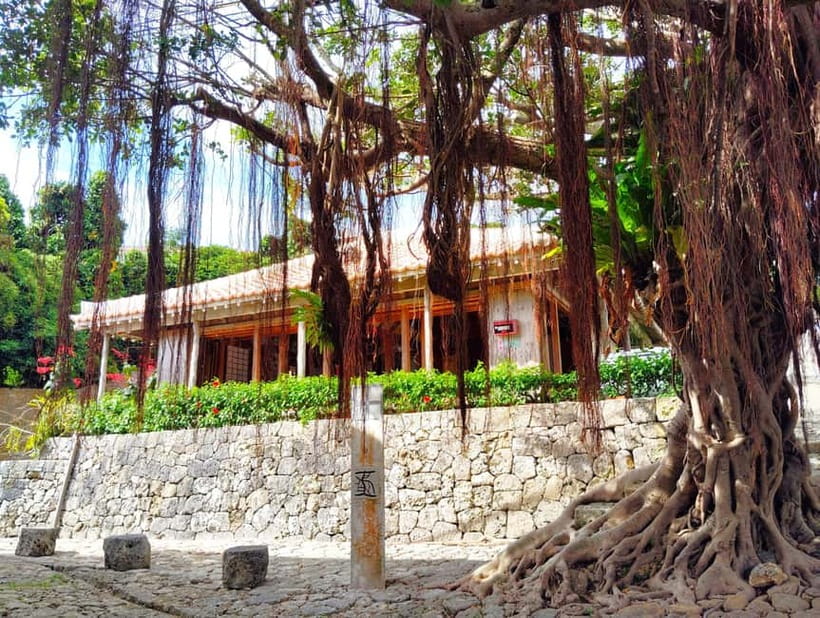
From Shurijo, the tour continues to Tamaudun, the royal mausoleum built in the early 16th century. The walk from the castle is short, but the mood changes quickly.
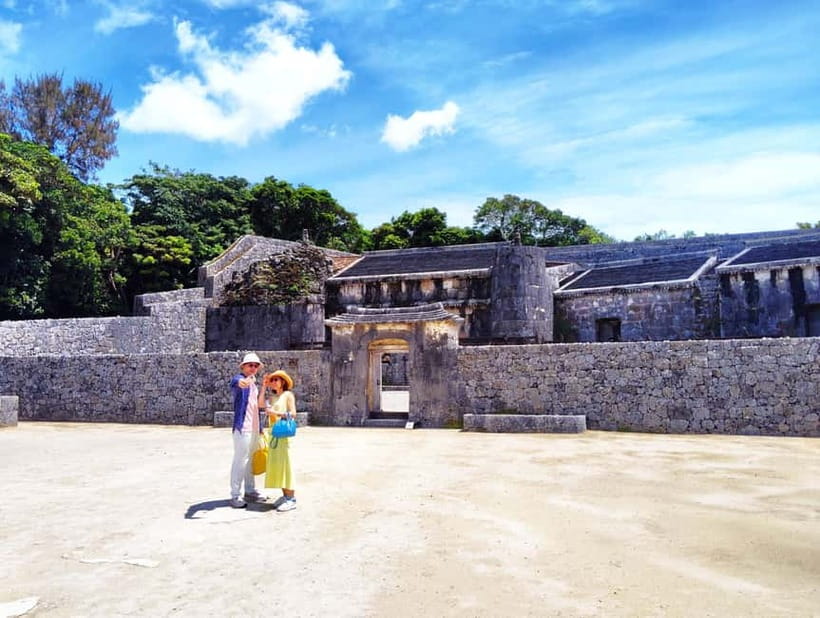
Tamaudun is built from Ryukyuan limestone and enclosed by thick stone walls. It is quieter and more solemn than the castle. The mausoleum was made for the kings and queens of the Ryukyu Kingdom, so it offers a direct look at dynastic continuity and the importance of royal ancestors.
This is one of the strongest parts of the experience for anyone interested in how societies understand death. Ryukyuan beliefs gave the dead an ongoing place within family and political life. The mausoleum was not simply a storage place for remains. It helped connect the living court with the royal line that came before it.
Your guide can also explain why Tamaudun sits so close to Shurijo. The arrangement makes the relationship between governing power and spiritual lineage easy to see. The royal court needed sacred legitimacy, and the royal dead remained part of that story.
Allow about 45 minutes here. That is enough time for a guided visit and photographs without turning a serious place into a quick photo stop. I would keep your attention on the walls, setting, and meaning of the site rather than expecting an elaborate interior experience.
Kinjo Stone-Paved Road puts you among the old capital’s daily life
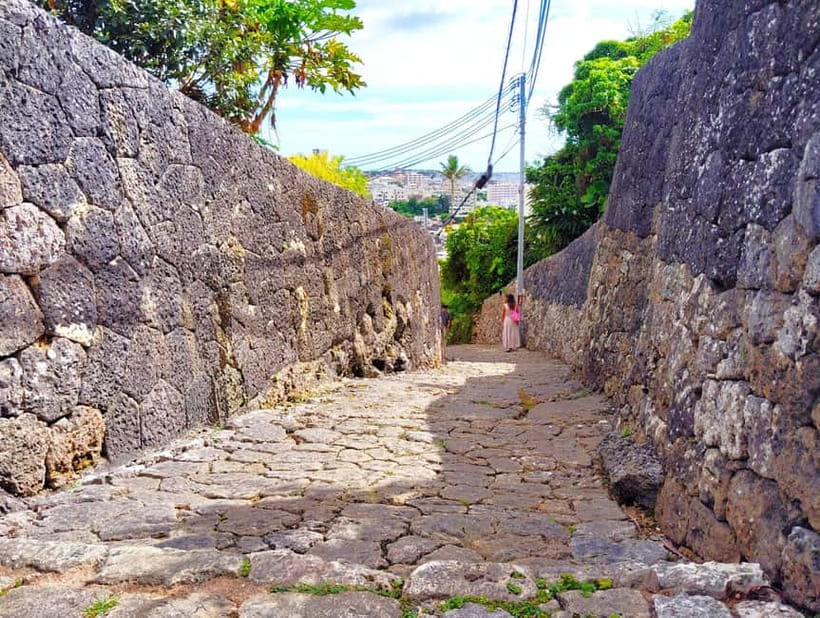
The final major stop is Kinjo Stone-Paved Road, a traditional slope paved with Ryukyuan stone. After the formal spaces of the castle and mausoleum, this walk gives you a more grounded view of the old capital.
The road passes through forested sections and alongside old homes and stone walls. It lets you feel the uneven surfaces and changing slope under your feet, which is more revealing than viewing historic streets from a bus or a museum display.
The walk is scheduled for about 30 minutes. That is brief, but it works well after the castle and Tamaudun. You get a physical sense of how people moved through the old royal district, and you see the textures of ordinary life that grand palace buildings cannot provide.
Wear shoes suited to walking on stone and sloped ground. The route is not described as a long hike, but its traditional paving can be less comfortable than a smooth sidewalk. If you prefer only major monuments and indoor exhibits, this part may feel less essential. I find it valuable precisely because it slows the tour down and shifts attention away from royal ceremony.
The experience finishes at Kinjo Muraya, also written as Kanagushiku Muraya. Since the walk ends there rather than returning you to the original meeting point, plan your next move before you start.
Same walls, a different way in:
- Osaka Castle: Museum and Tower Entry Ticket
★ 4.5 · 2,380 reviews - Tokyo Castle & Imperial PalaceーShogun Walking Tour
★ 4.7 · 1,068 reviews - Ultimate Osaka Walking Tour: Castle, Dotonbori & Hidden Gems
★ 5.0 · 862 reviews - Tokyo Castle & Imperial PalaceーShogun Walking Tour
★ 5.0 · 724 reviews
The sunrise Opening Gate Ceremony is the special option
The early morning version is the most distinctive choice. It gives you the chance to see Shurijo’s Opening Gate Ceremony, held only at sunrise.
The ceremony adds a sense of ritual that a standard daytime visit cannot match. Shurijo was a place of court ceremony and sacred authority, so seeing the gates open at the start of the day fits the site’s character.
The tradeoff is simple: you must be ready for an early start. The exact starting time depends on availability and the season, so check the schedule when booking. This option suits you if you enjoy atmosphere, ceremony, and quieter historic sites more than a relaxed morning.
It is also a good choice for repeat visitors to Okinawa. If you have already seen the castle grounds in daylight, the opening ceremony offers a different experience without changing the central route.
Starting from Naha Airport can make arrival day easier
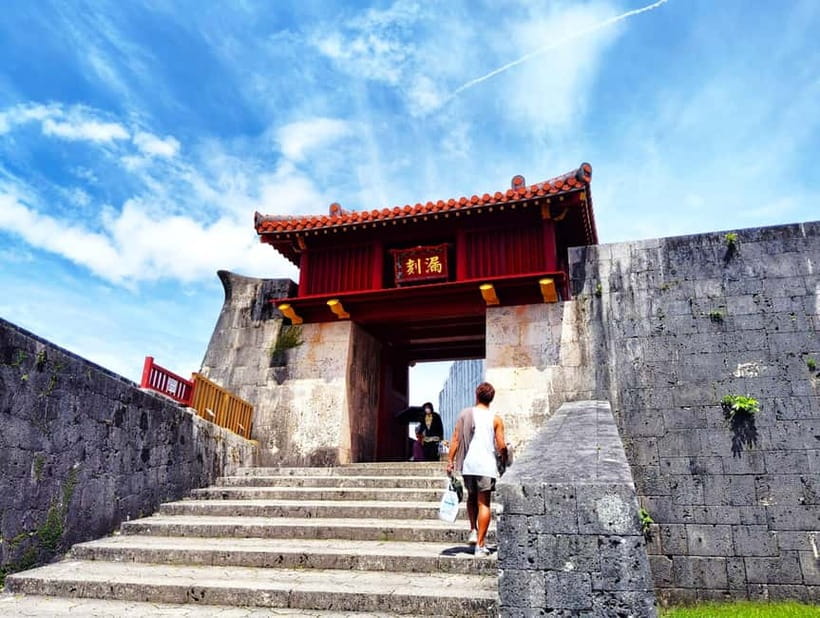
One option begins at Naha Airport Station. Your guide meets you at the monorail station and accompanies you to Shurijo Castle.
This is useful if you want to begin sightseeing as soon as you arrive in Okinawa. You do not have to arrange a separate first visit to the castle or work out the route alone while carrying your arrival-day luggage. The guide-led transfer also gives you an immediate introduction to the area.
The airport start is optional, and meeting details vary by the option selected. Read the exact starting instructions carefully. The other standard meeting point is Shureimon, the famous gate associated with Shurijo.
Because the tour ends at Kinjo Muraya, airport transportation is not automatically a return trip after the walk. The provided information specifies transportation from Naha Airport as an optional service, so confirm exactly what is included in your chosen version before assuming you will be returned to the airport.
A private guide makes the history easier to follow
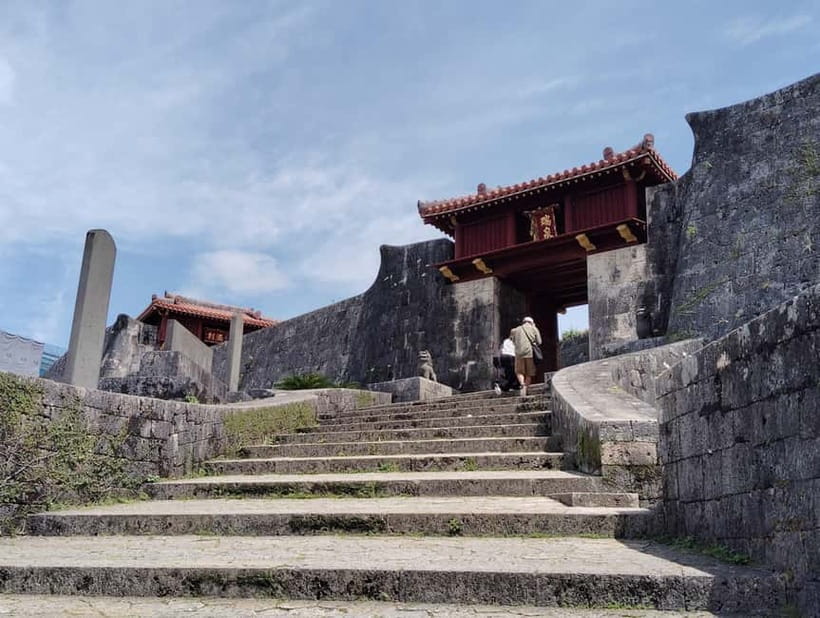
This is a private English-language tour lasting about three hours, with some versions running closer to four hours. That format suits you if you want to ask questions about Okinawan culture instead of listening to a fixed script from a large group.
The route includes roughly 1.5 hours at Shurijo Castle, 45 minutes at Tamaudun, and 30 minutes on Kinjo Stone-Paved Road. The timing gives the castle the most attention, as it should, while still protecting space for the mausoleum and street walk.
Sara is one guide associated with this experience. If she leads your tour, expect a friendly and engaging approach with detailed historical explanation. She is also known for offering extra recommendations for the rest of an Okinawa visit and, when appropriate, adding a few nearby historical points to the outing.
That kind of help can be especially useful on a first trip to Okinawa. The kingdom’s history involves local powers, foreign relationships, court traditions, and religious ideas that are not always easy to connect on your own. A good guide turns separate buildings into one story.
Still, a private guide cannot remove every limitation. The Main Hall remains under restoration, the tour involves walking on stone, and the route is focused on the Shurijo area rather than covering several distant Okinawa sights.
Is $97 a fair price?
At $97 per person, this is not the cheapest way to see Shurijo Castle. The value depends on what you want from the visit.
For a quick look at the grounds, you can spend less by visiting independently. The price makes more sense if you want a private guide, English explanations, a connected route through three important sites, and the option of airport pickup or the sunrise ceremony.
You are paying for interpretation as much as admission or walking time. The most useful part is learning why Shurijo was built as a diplomatic court, how Tamaudun fits into royal beliefs, and why sacred sites remain important on the castle grounds.
The airport start may also save time and uncertainty on arrival day. The early morning option has a different kind of value, since the Opening Gate Ceremony is not part of a normal daytime visit.
I would consider the price worthwhile for first-time visitors, history fans, and anyone traveling privately with one or two companions. It is less attractive if your main goal is simply to take photographs of the castle exterior or if you are comfortable researching the sites yourself.
Who will enjoy this Okinawa walk most?
I would recommend it most strongly to you if you want cultural context, not just landmark collecting. The route works particularly well for first-time visitors who need a clear introduction to the Ryukyu Kingdom.
It also suits couples and small private groups who prefer the freedom to ask questions. Families with older children may appreciate the mix of palace architecture, royal tombs, sacred places, and an old stone road, though the subject of Tamaudun is more serious than a standard sightseeing stop.
Choose the sunrise version if ceremony and atmosphere matter to you. Choose the airport version if you want to turn your arrival into a useful half-day of sightseeing.
You may want to skip it if you need a fully restored castle interior, dislike sloped stone paths, or have only a short time in Naha and want to see many unrelated sights. This tour stays focused on one historic area.
Practical details before you go
The tour is offered in English and uses a live guide. Meeting points can vary, with options listed at Naha Airport Station and Shureimon.
The standard route lasts about three hours, while some options take three to four hours. Check the available starting times, especially for the sunrise version.
You can cancel up to 24 hours in advance for a full refund, and the reservation option allows you to pay later. Those policies are useful if your Okinawa schedule is still shifting.
Bring comfortable footwear for the Kinjo Stone-Paved Road and allow time for a thoughtful visit at Tamaudun. Since the tour finishes at Kinjo Muraya, do not assume you will return to your starting point unless your selected option specifically says so.
Should you book this Shurijo tour?
Book it if you want Okinawa’s old capital explained as a living connection between royal power, international diplomacy, sacred tradition, and ordinary streets. The pairing of Shurijo Castle with Tamaudun is the real strength. Kinjo Stone-Paved Road then gives the history a physical, everyday setting.
I would choose the sunrise version for atmosphere or the Naha Airport start for convenience. Just remember that Shurijo is still being restored after the 2019 fire, and the main hall is not fully available.
If that limitation does not bother you, the private format and focused route make this a strong introduction to Okinawa’s Ryukyuan past. If you only want a complete palace interior, wait until restoration progresses or visit independently with modest expectations.
FAQ
How long does the Shurijo Castle tour take?
The experience lasts about three to four hours, with the guided walking portion described as approximately three hours.
What places are included?
The route includes Shurijo Castle, Tamaudun royal mausoleum, and Kinjo Stone-Paved Road.
Can I start the tour at Naha Airport?
Yes. One option begins at Naha Airport Station, where the guide meets you and accompanies you to Shurijo Castle.
Is there an early morning version?
Yes. The optional morning tour includes the Opening Gate Ceremony, which is held at sunrise.
Is Shurijo Castle fully open after the fire?
No. The Main Hall, or Seiden, was destroyed by fire in 2019 and is under restoration. Other castle grounds, sacred sites, walls, and viewpoints remain part of the visit.
What language is the tour offered in?
The live tour guide speaks English, and the experience is arranged as a private group.
Newly walked in Japan
- Tokyo: Edo Castle and Imperial Palace Guided Walking Tour★ 5.0 · 6 reviews
- (Ticket Included) Explore Osaka Castle & Museum of History★ 4.8 · 21 reviews
- Peace Memorial Park, Hiroshima Castle, & Garden Private Tour★ 4.8 · 7 reviews
- Osaka: Osaka Castle – Tsuruhashi – Tennoji (Spanish Guide)★ 4.7 · 10 reviews
- Osaka/kyoto: Himeji Castle, Kobe. Luxury Day Trip with Guide★ 5.0 · 2 reviews
- Osaka: Osaka Castle 3 hours Historical Walking Tour★ 4.6 · 14 reviews
- Osaka: Early Morning Osaka Castle Guided Tour, Avoid Crowds★ 4.9 · 12 reviews
- Osaka: Explore Every Bit of Osaka Castle in 3 Hours★ 5.0 · 5 reviews
Guided Castle Tours, compared.

Edinburgh Castle: Guided Walking Tour with Entry Ticket
Read our review →
Cathedral, Giralda & Alcazar Entry With Guided Tour
Read our review →Edinburgh Castle: Guided Walking Tour with Entry Ticket
Read our review →
Stonehenge, Windsor Castle and Bath Full Day Guided Tour
Read our review →
Alcázar of Seville Skip-the-Line Tickets and Guided Tour
Read our review →
Dublin Book of Kells, Castle and Molly Malone Statue Guided Tour
Read our review →

Quebec City: Guided Tour of Fairmont Le Château Frontenac
Read our review →Browse the lists this tour appears in